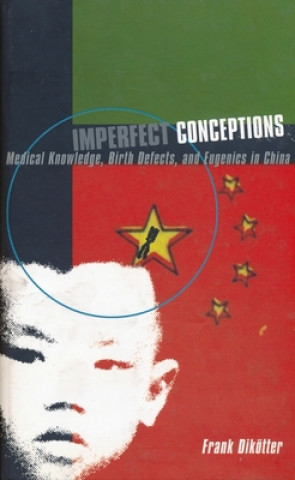
In 1995 the People's Republic of China passed a controversial Eugenics Law, which, after a torrent of international criticism, was euphemistically renamed the Maternal and Infant Health Law. Aimed at "the implementation of premarital medical checkups" to ensure that neither partner has any hereditary, venereal, reproductive, or mental disorders, the ordinance implies that those deemed "unsuitable for reproduction" should undergo sterilization or abortion or remain celibate in order to prevent "inferior births." Using this recent statute as a springboard, Frank Dikotter explores the contexts and history of eugenics in both Communist China and Taiwan. Dikotter shows how beginning in Late Imperial China, Western eugenics was imported and combined with existing fears of cultural, racial, or biological degeneration in Chinese society, leading to government regulation of sexual reproduction. Imperfect Conceptions is a revealing look at the cultural history of medical explanations of birth defects that demonstrates how Chinese assumptions about the relationship of the individual to society form the very core of their attitudes toward procreation.
Dikotter explains the patrilineal model of descent, where a person is viewed as the culmination of his or her ancestors and is held responsible for the health of all future generations. By this logic, a pregnant woman's behavior and attitude directly influence the well-being of her baby, and a deformed or retarded child reflects a moral failing on the part of the parents. Dikotter also shows how the holistic medicine practiced in China blurs any distinction between individual and environment so that people are held responsible for illness. Drawing on cultural, social, economic, and political approaches, Dikotter goes beyond a simple authoritarian model to provide a more complex view of eugenic policy, showing how a variety of voices including those of popular journalists, social reformers, medical writers, sex educators, university professors, and politicians all disseminate information that supports rather than questions the state's program.
Imperfect Conceptions reveals how Chinese cultural currents -- fear and fascination with the deviant and the urge to draw clear boundaries between the normal and the abnormal -- have combined with medical discourse to form a program of eugenics that is viewed with alarm by the rest of the world.