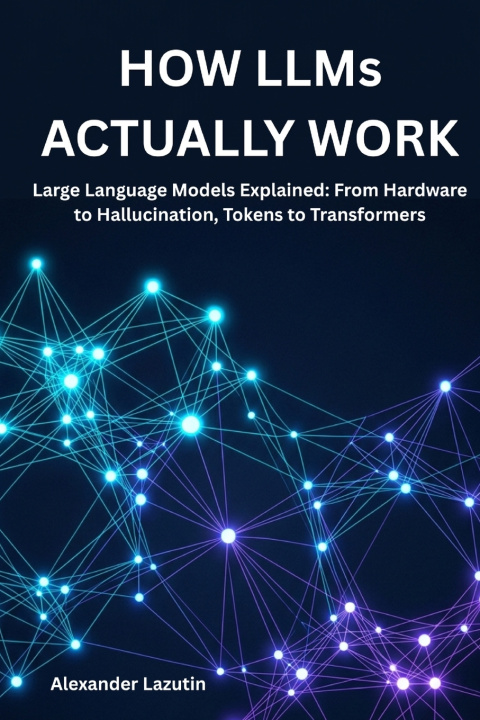
Millions of people use AI tools every day. Almost none of them can explain what is actually happening inside them.
You use ChatGPT, Claude, or Gemini. You may use them daily. You have watched colleagues, clients, and competitors talk confidently about large language models. And somewhere in the back of your mind, a question has stayed unanswered: what is this thing, really?
Not the press-release version. Not the science fiction version. The real one.
How LLMs Actually Work is the book that finally answers that question, covering everything from the physical hardware that runs these systems to why they hallucinate, from the mathematics of meaning to how agents and AI coworkers are built. No code. No condescension. No hype.
What you will understand by the last page
This is not a book about how to use AI tools. It is a book about how they work, at the level of mechanism, written for smart professionals who want a genuine explanation rather than a simplified version of one.
- Tokens, embeddings, and attention: how text becomes mathematics and why this shapes everything the model does
- The transformer architecture: the 2017 paper that changed everything, explained without a single equation
- Training and alignment: what pre-training, RLHF, and Constitutional AI actually involve, who does it, and who funds it
- Hallucination, explained mechanistically: why confident wrong answers are a structural feature, not a bug waiting to be fixed
- Beyond text: how image generation, voice synthesis, and video generation work using the same underlying ideas
- RAG, memory, and agents: how models get access to current information and the ability to take actions in the world
- The model landscape in 2026: open versus closed models, quantisation, distillation, and the geopolitics of AI
- Best uses and real limits: a clear-eyed framework for when to trust model outputs and when to verify them
Who this is for
You work in technology, finance, law, consulting, healthcare, or any field where AI tools are changing how work gets done. You use these systems, make decisions about them, and explain them to others. You want to understand what is under the hood well enough to think clearly about all of the above.
No mathematics required. No programming background required. A willingness to follow a careful argument to a genuinely surprising conclusion is all this book asks.
What makes this different
The existing books about AI divide into two camps: sweeping narratives about civilisational change that tell you these systems matter without explaining how they work, and dense technical texts that require a computer science degree to read. How LLMs Actually Work occupies the space between them. Rigorous without being a textbook. Accessible without being vague. It explains the genuine mechanism, through intuition and analogy, in language that respects your intelligence.
The people who use these systems most effectively are not the ones who trust them most. They are the ones who understand them best.
Covers large language models, GPT, Claude, Gemini, transformer architecture, tokenisation, embeddings, attention mechanisms, RLHF, Constitutional AI, retrieval-augmented generation, diffusion models, AI agents, quantisation, distillation, open source AI, Llama, Mistral, hallucination, scaling laws, and the complete model landscape in 2026.