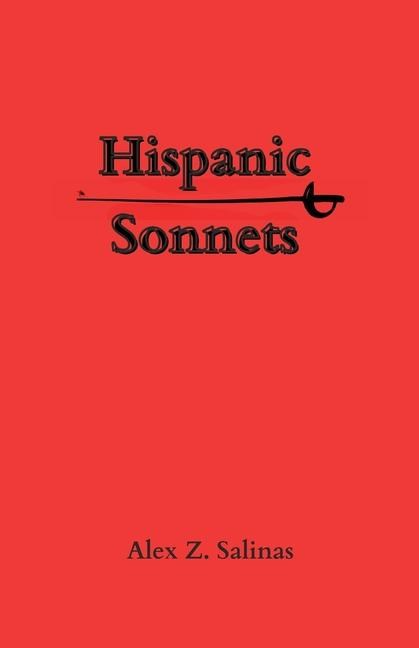
In Alex Z. Salinas' previous poetry collections, he commenced conversation between the damaged body politic within himself and the bizarre, sometimes beautiful dream worlds of writers, painters and musicians-Muses-living and dead. In Hispanic Sonnets, the dials are turned up, the stakes (whatever they may be) are heavier, and the chorus of voices is louder, clearer. Hispanic Sonnets is part homage to the venerated and part turning the other cheek. In the final section of this book, a series of 15-line, free-verse sonnets continue the dialogue Salinas started in South Texas, or, to him, the center of his heart. This collection is the dream the poet still lives in, shattered and stitched back together with family, love, loss, pride and dignity; in short, Hispanic Sonnets is the book that least embarrasses him.
A note on Hispanic sonnets
What is a Hispanic sonnet? It is a 15-line, free-verse poem with a separated last line as its own
stanza. Each Hispanic sonnet's second and final stanza-that lonely little manmade
island-serves as its volta, or turn, meaning that where the poem ends in idea, tone, or spirit is
not necessarily where it begins.
Let it be known, then: a Hispanic sonnet is not really a sonnet.
Shakespeare transformed the 14-line English sonnet. Petrarch perfected the much-older 14-line
Italian sonnet. Wanda Coleman dazzled with her rule-busting, 14-line American sonnets, and
Terrance Hayes carried her tradition to new heights.
Corpus Christi's first Poet Laureate, Alan Berecka, informed me that writers he'd encountered
have penned 15-line sonnets called quince sonnets. Having never attended a quinceañera or a
quinceañero, I-a non-Spanish-speaking South Texan-smiled upon learning this grain of
poetry's organic history. Quince sonnets seemed to me, naturally, inevitable. The sweetest,
tangiest apples and oranges ever within reach.
The poet Iliana Rocha, whom I had the pleasure to read with on a virtual open mic, has authored
a beautiful, 18-line (by my count) poem titled "Mexican American Sonnet." Juan Felipe Herrera,
former United States Poet Laureate and the first Hispanic appointed to that role, once told me
he'd removed commas from a poem after having mastered them.
It is in this shadow, perhaps, that I arrived at the Hispanic sonnet, whose name is the only
invention herein I claim. The chasm between two stanzas representing everything and
nothing-the worst and best of what we are capable of in community and in solitude.
Everything else remains an inevitability.