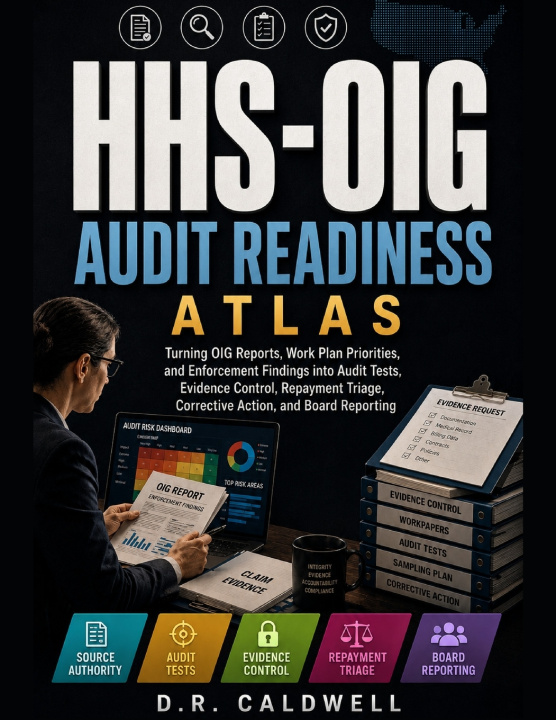
Turn HHS-OIG Oversight Into Audit Work Your Organization Can Run
HHS-OIG audit readiness is not built by collecting reports or treating every Work Plan item as a finding. It is built by converting each signal into a documented decision, objective, evidence request, workpaper, and board action.
One Operating System From Signal to Board Report
The HHS-OIG Audit Readiness Atlas gives compliance and internal-audit teams a twelve-step loop. Monitor. Label authority. Decide applicability. Rank risk. Set the objective. Request evidence. Test the control. Plan the sample. Classify the finding. Route questions. Build corrective action. Report and refresh.
Know What Every Source Can-and Cannot-Prove
Use a twelve-class system to separate binding rules from CMS manuals, voluntary OIG guidance, audit findings, recommendations, Work Plan projects, allegations, settlements, corporate integrity agreements, advisory material, and industry references. Stop another entity's finding from becoming your conclusion.
Build Audits That Survive Review
• Create an owned OIG risk-universe register.
• Score exposure, patient harm, frequency, control maturity, prior findings, and regulatory focus.
• Use the locked twenty-field audit-test format.
• Reconcile populations before sampling.
• Request proof that a control operated-not merely that paperwork exists.
• Separate control design from operating effectiveness.
• Record, validate, classify, and route every exception.
• Close corrective action only after validation and retesting.
Keep Specialized Decisions With Their Owners
Six review gates stop audit where specialized judgment begins. Route privilege, repayment, disclosure, fraud, and report-and-return questions to counsel. Send code assignment to coding review, medical necessity to clinical review, projections to a statistician, security conclusions to cybersecurity specialists, and reserve questions to finance.
Apply One Method Across Five High-Risk Sectors
Run modules for Medicare Advantage, Medicaid applied behavior analysis, DMEPOS, nursing facilities, and healthcare cybersecurity. Ten audit programs cover diagnosis support, prior-authorization timeliness, provider qualification, treatment plans, order and delivery records, inpatient overlap, antipsychotic governance, staffing-data accuracy, multifactor-authentication coverage, and incident-response evidence.
Move From Findings to Proven Corrective Action
Trace each issue to a control-layer root cause. Assign one owner, milestones, implementation evidence, independent validation, a fresh-population retest, closure criteria, recurrence monitoring, and repeat-finding escalation. A policy update or manager assurance does not close a finding. Evidence does.
Give Management and Directors the View They Need
Convert technical work into one-page reporting built around identified exposure, ownership, overdue action, repeat findings, unresolved decisions, and the board action requested. Keep identified potential exposure separate from determined liability.
Thirty Blank Master Tools and Completed Models
Deploy risk registers, scoring models, audit programs, evidence packages, workpapers, sampling plans, severity matrices, gate referrals, repayment pathways, corrective-action plans, dashboards, surveillance registers, and edition controls. Completed examples show the finished work before you build your own.
Build the System Once. Refresh the Facts as They Change.
Use quarterly surveillance, superseded-source controls, verification registers, and an annual universe refresh to keep the Atlas current without rebuilding the method. Start with the risk universe, assign the owner, and turn the OIG signal into documented audit action.