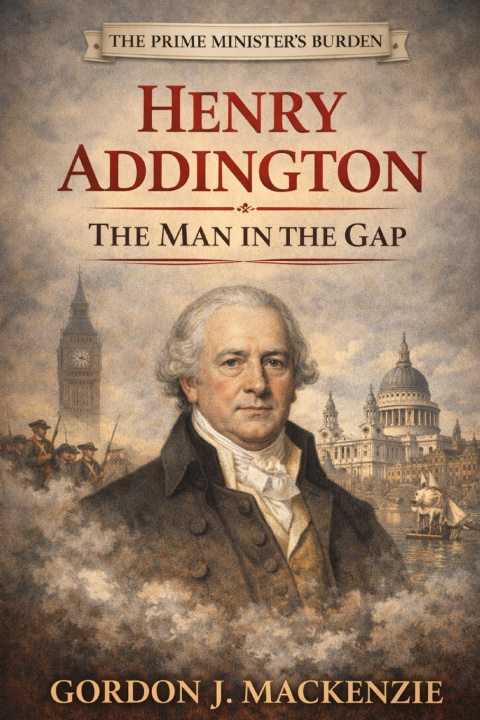
Henry Addington is often remembered as a footnote.
The safe man.
The temporary prime minister.
The space between Pitt.
That memory is wrong.
In Henry Addington, Gordon J. MacKenzie restores one of Britain's most misunderstood leaders to his proper place in history. At the height of the Napoleonic crisis, Addington took office not as a conqueror, but as a stabiliser - tasked with holding a nation together as it balanced exhaustion, fear, and the need for recovery.
His government delivered the Peace of Amiens, giving Britain a rare moment to breathe. But when war returned, the same decision that once brought strength became the reason for his downfall.
Replaced by Pitt, Addington's reputation collapsed into simplicity.
Yet he did not disappear.
As Viscount Sidmouth, he became one of the most powerful figures in Britain's internal government, shaping how the state responded to unrest, reform, and growing political tension. In doing so, he revealed a deeper truth about Britain itself - a nation that demanded strength, but needed relief; that valued liberty, but feared disorder.
This is not the story of a great man in the traditional sense.
It is the story of a necessary one.