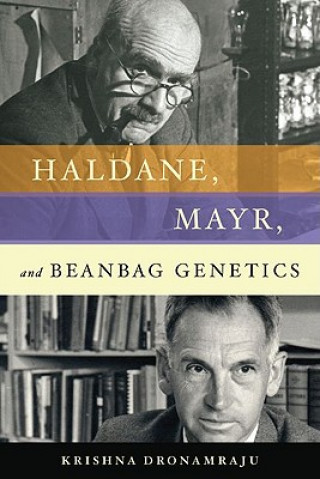
Książka Haldane, Mayr, and Beanbag Genetics Krishna Dronamraju

Haldane, Mayr, and Beanbag Genetics

Język: Angielski
Oprawa: Twarda
Dostępność: Dostępna u dostawcy
Wysyłamy za 10-18 dni
214.71
Haldane, Mayr, and Beanbag Genetics presents a summary of the classic exchange between two great bio...
Informacje o książce

Język
Angielski
Oprawa
Książka - Twarda
Data wydania
2011
strony
296
EAN
9780195387346
ISBN
0195387341
Enbook ID
04359271
Waga
448
Wymiary
149 x 214 x 22

Pełny opis

Haldane, Mayr, and Beanbag Genetics presents a summary of the classic exchange between two great biologists - J.B.S. Haldane and Ernst Mayr - regarding the value of the contributions of the mathematical school represented by J.B.S. Haldane, R.A. Fisher and S. Wright to the theory of evolution. Their pioneering contributions from 1918 to the 1960s dominated and shaped the field of population genetics, unique in the annals of science. In 1959, Mayr questioned what he regarded as the beanbag genetic approach of these pioneers to evolutionary theory, "an input or output of genes, as the adding of certain beans to a beanbag and the withdrawing of others." In 1964, Mayr's contention was refuted by Haldane in a remarkably witty, vigorous and pungent essay, "A defense of beanbag genetics" which compared the mathematical theory to a scaffolding within which a reasonably secure theory expressible in words may be built up. Correspondence between Haldane and Mayr is included. Beanbag genetics has come a long way since 1964. Mayr's (1959) critique of simple uncomplicated population genetics is no longer valid. Population genetics today includes much more than Mayr's beanbag genetics. Population genetics models now include multiple factors, linkage, dominance and epistasis. These may be regarded as the advanced beanbag models. Furthermore, population genetics and developmental genetics have become interdependent. Contemporary beanbag genetics includes molecular clocks, nucleotide diversity, coalescence and DNA-based phylogenetic trees, along with the four major holdovers from classical genetics, mutation, selection, migration and random drift. Molecular genetics has made it possible to study evolution rates at the nucleotide level. It is also possible today to compare DNA similarities and divergence in diverse species of animals and plants, which were not previously crossable.

Możesz być zainteresowany

Konstantinople

Matthew F Amati
52.97
222.47
281.43
43.11
97.19

Cynthia's Reading Log

Martha Day Zschock
35.25
625.42
136.93

FEELING GOOD

LESLIE SEARLE
74.18
174.47
48.69
73.49
81.65
72.09

Klienci, którzy kupili tę książkę, kupili również

328.84
57.05
39.63
223.17
90.92

Martin Paz

Jules Verne
44.31

Slovutný pán prezident

Madeline Vadkerty
87.03
27.97

Louis XIV - Le lever du soleil

Jean-Pierre Dufreigne
50.88