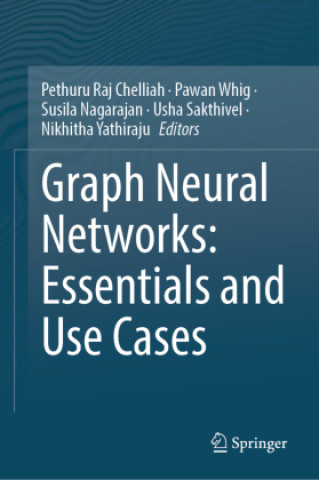
This book explains the technologies and tools that underpin GNNs, offering a clear and practical guide to their industrial applications and use cases. AI engineers, data scientists, and researchers in AI and graph theory will find detailed insights into the latest trends and innovations driving this dynamic field. With practical chapters demonstrating how GNNs are reshaping various industry verticals and how they complement advances in generative, agentic, and physical AI this book is an essential resource for understanding and leveraging their potential.
The neural network paradigm has surged in popularity for its ability to uncover hidden patterns within vast datasets. This transformative technology has spurred global innovations, particularly through the evolution of deep neural networks (DNNs). Convolutional neural networks (CNNs) have revolutionized computer vision, while recurrent neural networks (RNNs) and their advanced variants have automated natural language processing tasks such as speech recognition, translation, and content generation.
Traditional DNNs primarily handle Euclidean data, yet many real-world problems involve non-Euclidean data complex relationships and interactions naturally represented as graphs. This challenge has driven the rise of graph neural networks (GNNs), an approach that extends deep learning into new domains.
GNNs are powerful models designed to work with graph-structured data, where nodes represent individual data points and edges denote the relationships between them. Several variants have emerged:
- Graph Convolutional Networks (GCNs): These networks learn from a node s local neighborhood by aggregating information from adjacent nodes, updating the node s representation in the process.
- Graph Attentional Networks (GATs): By incorporating attention mechanisms, GATs focus on the most relevant neighbors during aggregation, enhancing model performance.
- Graph Recurrent Networks (GRNs): These networks combine principles from RNNs with graph structures to capture dynamic relationships within the data.
GNNs are applied in a variety of advanced use cases, including node classification, link prediction, graph clustering, anomaly detection, recommendation systems, and also in natural language processing and computer vision. They help forecast traffic patterns, analyze molecular structures, verify programs, predict social influence, model electronic health records, and map brain networks.