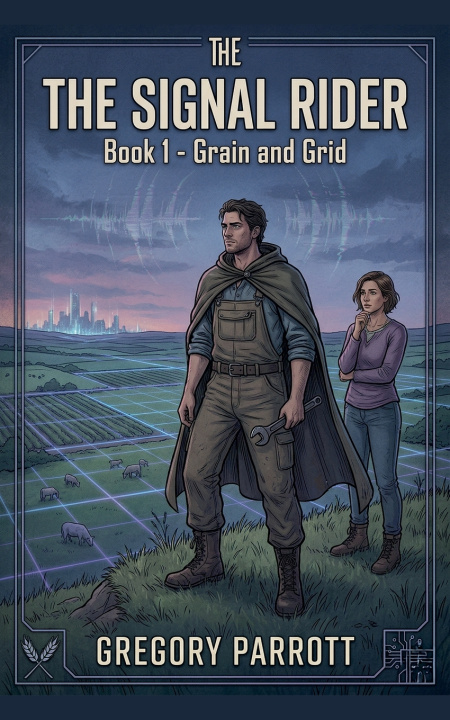
In a near-future world, where agriculture is fully automated and vast fields stretch in perfect, unblemished grids, Jaceon Rook (known as Silas) is a young, disillusioned mechanic. He lives in a rural farm town, a place of quiet efficiency, but feels a deep disconnect from the sterile perfection around him. Jaceon still believes in the feel of dirt under his nails, the hum of an engine he can truly understand, and the raw, unpolished sound of music that isn't digitally synthesized. His closest companion and confidant is Emry Vale, a childhood friend or family member who shares his quiet restlessness.
Grain and Grid introduces Jaceon's world, a place where roots clash with relentless progress. He spends his days maintaining the very machines that have replaced human labor, observing the subtle flaws in the "perfect" system. He finds solace in tinkering with old, discarded tech, trying to coax forgotten sounds from broken devices, and sharing his quiet observations with Emry. The themes of the book revolve around the tension between tradition and technology, authenticity versus manufactured efficiency, and the yearning for something more meaningful than a perfectly optimized existence.
The narrative follows Jaceon's growing restlessness and his subtle acts of rebellion-modifying farm equipment to play unauthorized frequencies, discovering hidden pockets of analog sound. He begins to pick up strange, faint "signals" in the static, hints of a world beyond his controlled environment. The book culminates with Jaceon making the difficult decision to leave the farmland, drawn by the allure of these mysterious signals and the promise of a more authentic, albeit chaotic, life in the neon-drenched megacities, leaving Emry and his familiar world behind for the unknown.