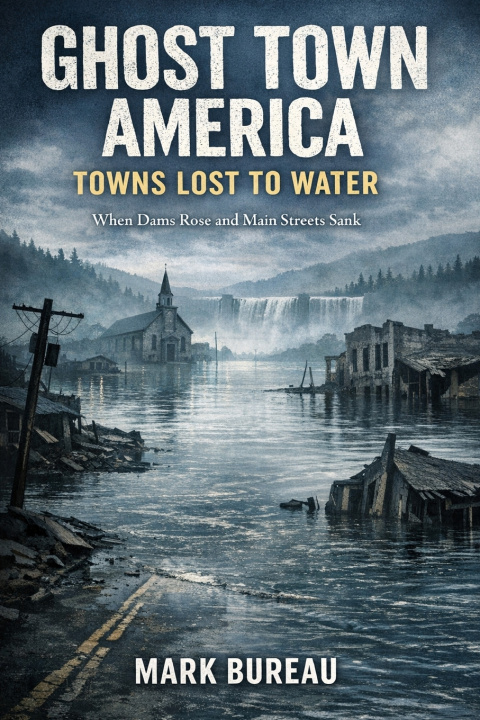
Ghost Town America: Towns Lost to Water tells the story of thirty American communities that were erased not by myth, but by rising reservoirs, redirected rivers, breached flood walls, collapsing shorelines, earthquake waves, and the long force of open water. Across New England valleys, Appalachian hollows, Southern power lakes, western canyons, and exposed coastal edges, these towns were not empty places waiting to disappear. They were real communities with schools, churches, stores, farms, ferries, fish camps, county courthouses, hotel lobbies, and family ground that once seemed certain to hold.
Some were condemned so that expanding cities could drink. Some were displaced by dams built for power, storage, navigation, or flood control. Others were broken when rivers changed course, shorelines retreated, or the sea kept taking land faster than any family or county could defend it. A few vanished in sudden catastrophe. Others were lost through years of surveying, arguing, buying, dismantling, waiting, and finally leaving. In every case, water did more than cover land. It reordered the map and forced people to surrender places that had organized daily life for generations.
This book moves from Dana and Enfield in the Quabbin watershed to New York City's removed reservoir towns, through drowned TVA valleys, Southern courthouse relocations, lost Western settlements, and coastal communities such as Vanport, Holland Island, Chenega, and Bayocean. Along the way, it asks a harder question than where these places went. It asks what kind of country creates public gain out of local disappearance, and why the benefits remain visible long after the sacrifice has been forgotten.
These chapters do not treat ghost towns as curiosities or scenic ruins. They treat them as working places shaped by transportation, subsistence, law, engineering, commerce, and geography. The people in these towns were not standing outside history. They were living inside it, often on land whose value only became obvious to larger systems once the decision had already been made elsewhere.
You will meet towns that were studied, priced, dismantled, and drowned in the name of progress. You will also meet places that were never formally condemned, only eroded, broken, or abandoned when water kept revising the boundary between habitable ground and open risk. In these pages, reservoirs, river cuts, inlets, and coastlines are not background scenery. They are active historical forces.
For readers drawn to American history, hidden landscapes, abandoned places, rivers, dams, and the changing relationship between land and power, Ghost Town America: Towns Lost to Water offers a deeper map of loss. It is a book about erased main streets, but it is also a book about memory, public need, environmental force, and the communities that paid the price when water became the stronger argument.
If you have ever looked across a reservoir, a river bend, or an empty shoreline and wondered what stood there before, this book is for you.