Książka Functional Structures in Networks Thomas G. Muth

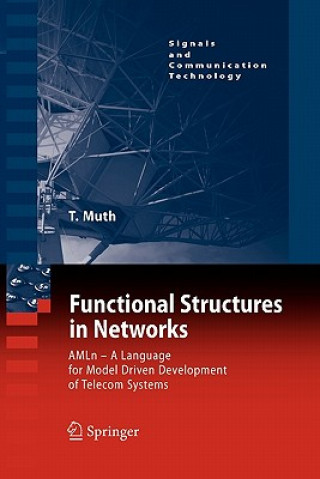
Functional Structures in Networks

AMLn - A Language for Model Driven Development of Telecom Systems

Język: Angielski
Oprawa: Miękka
Dostępność: Dostępna u dostawcy w małych ilościach
Wysyłamy za 13-18 dni
470.91
Designed to make life easier for most network designers, whether they are a manager with technical b...


Informacje o książce

Język
Angielski
Oprawa
Książka - Miękka
Data wydania
2010
strony
280
EAN
9783642061417
ISBN
3642061419
Enbook ID
01651424
Waga
456
Wymiary
155 x 235 x 17

Pełny opis

Designed to make life easier for most network designers, whether they are a manager with technical background, work with standardization, the architecture of implementers solutions to standards, product design (constructing the software and hardware parts of operator networks), system testing, and for operators responsible for the configuration and maintenance of a network. §Develops modeling as a basic principle for producing specifications turns design from being document driven to model-driven. In the context of this book, however, the only model type that is discussed is the information model that describes the purpose, structure, and behavior of a network. §Presents an added-value modeling language that called AMLn (Abstract Modeling Language, network view), which is the first and, so far, the only attempt to create a modeling language for network systems.The book describes a method for creating models of telecom systems. The method is intended for practicing network architects and designers. This method emphasizes modeling the (very complex) functional structure of networks in a way that is independent of any hardware and software design methodology. The method also allows designers to express their model in two main views: a generic view and a system view that takes protocols and network configuration issues into account. The idea is to retain a stable view (the generic) in the context of constant changes and large variations within the system view. The expected benefits are large savings in telecom systems development and maintenance. The terminology is domain unique, i.e., based on de-facto telecom terminology. All concepts that are used in modeling are well defined. The purpose of using a telecom-oriented terminology instead of industry-standard methods for software and protocol design (e.g., UML and SDL) is to be able to create models that are expressive and intelligible for network architects and designers. Models are created as graphical models that show the functional and physical structure of networks at different levels of details. Information on properties, including behavior is attached to the models. A fairly small set of symbols is used in modeling.

Możesz być zainteresowany

Big Cash Robbery

Andrew Clover
35.82

Us Catholic Historian V 17 2

Christopher Kauffman
57.24

Genetics of Health

Sharad P Paul
58.79
724.91

Hell

Henri Barbusse
58.79

Dog Tails

Clive L Gilson
64.93

Creating Worldviews

James W Underhill
184.68

Klienci, którzy kupili tę książkę, kupili również

Dnevnik druge zime

Srđan Valjarević
75.25

Our Darkness

Dennis Burmeister
126.07
49.93

UN COMUN SINGULAR

PEREZ FONTDEVILA
148.36

Lire et s'entrainer

Alexandr Dumas
40.39

Welcome to California

Karin von Papstein
48.57
55.39

Magirus Kranwagen

Klaus Lassen
172.31
71.55

Ausreiseantrag

Eberhard Neckel
37.38

Grenzenlos

Vera Kühne
69.70

Flughunde

M Beyer
45.07