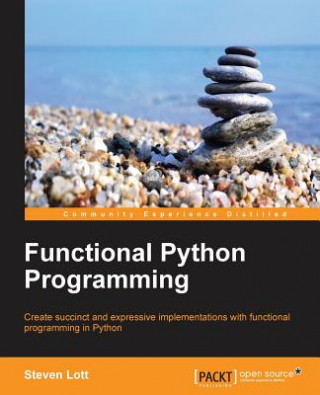
Książka Functional Python Programming Steven Lott

Functional Python Programming

Autor: Steven Lott
Język: Angielski
Oprawa: Miękka
Dostępność: Dostępna u dostawcy
Wysyłamy za 9-15 dni
231.41
Create succinct and expressive implementations with functional programming in PythonKey Features:Imp...
Informacje o książce

Autor
Język
Angielski
Oprawa
Książka - Miękka
Data wydania
2015
strony
360
EAN
9781784396992
ISBN
9781784396992
Enbook ID
03202721
Waga
678
Wymiary
237 x 196 x 24

Pełny opis

Create succinct and expressive implementations with functional programming in Python


Key Features:

  • Implement common functional programming design patterns and techniques in Python
  • Learn how to choose between imperative and functional approaches based on expressiveness, clarity, and performance
  • Apply functional Python to common Exploratory Data Analysis (EDA) programming problems


Book Description:

Python is an easy-to-learn and extensible programming language that offers a number of functional programming features. It's ideally suited to a number of applications in the broad space of data science.


This practical guide demonstrates the Python implementation of a number of functional programming techniques and design patterns. Starting with a general overview of functional programming concepts, you will explore common functional features such as first-class and higher-order functions, pure functions and more, and how these are accomplished in Python. Additionally, you will cover how common functional optimizations can be handled in Python. You'll also explore data preparation techniques and data exploration in depth. Moving on, you will learn how the Python standard library fits the functional programming model. The book concludes with a look at the PyMonad project and some larger examples.


By the end of this book, you will be able to understand what functional programming is all about, its impact on the programming workflow, why it's important, and how to implement it in Python.


What You Will Learn:

  • Use Python's generator functions and generator expressions to work with collections in a non-strict (or lazy) manner
  • Utilize Python library modules including itertools, functools, multiprocessing, and concurrent.futures for efficient functional programs
  • Use Python strings using object-oriented suffix notation and prefix notation
  • Avoid stateful classes with families of tuples
  • Design and implement decorators to create composite functions
  • Use functions like max(), min(), map(), filter(), and sorted()
  • Write higher-order functions


Who this book is for:

Możesz być zainteresowany

Fascists

Michael Mann
122.37

The Elemental Oracle

Stacey Demarco
77.97
85.76
80.02
37.57
66.58
57.72

Power

Michel Foucault
65.90

Lost in Math

Sabine Hossenfelder
56.56

Haikyu!!, Vol. 43

Haruichi Furudate
40.10

Persona 5

Pie International
125.19

Permission to Feel

Marc Brackett
74.47

Capturing the Devil

Kerri Maniscalco
61.81

WOLFPACK

Abby Wambach
58.11

Greenfeast

Nigel Slater
86.64
30.95

Aquamarine

Michele Fermanis-Winward
68.14

Klienci, którzy kupili tę książkę, kupili również

El amor en los tiempos del cólera

Gabriel García Márquez
53.54
60.64

L'Eau Et Le Mouvant

Yasmina Benferhat
195.77
35.33

Barça. Burzliwa dekada

Leszek Orłowski
39.23
183.02

Ando

Masao Furuyama
55.77
125.19

Deutsch fürs Lehramt

Monika Hoffmann
70.67