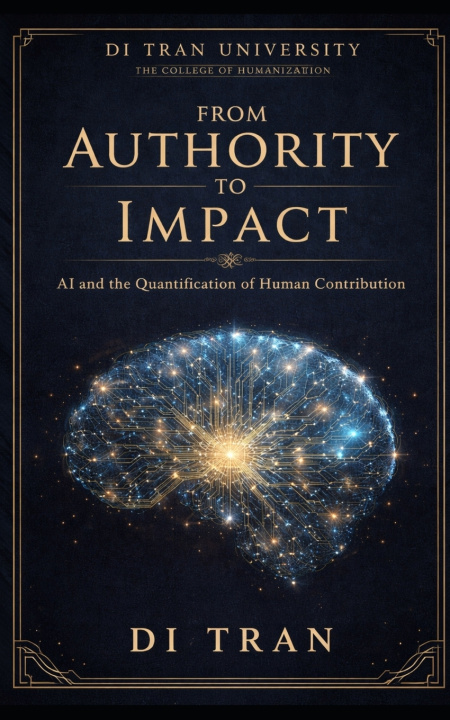
For centuries, society has relied on authority to determine credibility.
Degrees. Titles. Accreditation. Institutional approval.
These systems once made sense in a world where knowledge was scarce and trust had to be centralized. But artificial intelligence has changed the equation forever.
In From Authority to Impact, entrepreneur, educator, and founder of Di Tran University - The College of Humanization - Di Tran presents a bold and timely argument: humanity is entering a new credibility era where measurable contribution matters more than credentials, and real-world impact replaces static authority as the foundation of trust.
Drawing from global labor trends, education economics, AI development, and real-world institutional experience, this book explores:
Why traditional credential systems are losing dominance in the AI age
How artificial intelligence can synthesize knowledge beyond human-scale peer review
The rise of proof-of-work credibility and action-based reputation
The transformation of hiring, education, and professional validation worldwide
How human contribution may soon be quantified through digital reputation systems
The ethical risks and opportunities of measuring impact at scale
This is not a rejection of education or expertise. It is a redefinition of how credibility is formed when information becomes universally accessible and outcomes become measurable.
At its core, this book asks a fundamental question:
If authority no longer defines value, what does?
Part philosophy, part economic analysis, and part future-of-work blueprint, From Authority to Impact challenges readers to rethink how trust, contribution, and human worth will be understood in an AI-driven civilization.
This book is for:
educators and policymakers rethinking credential systems
entrepreneurs and builders operating in the proof-of-work economy
AI and technology leaders shaping the future of knowledge
students and professionals navigating a rapidly changing world
The future will not ask what title you held.
It will measure what you created.