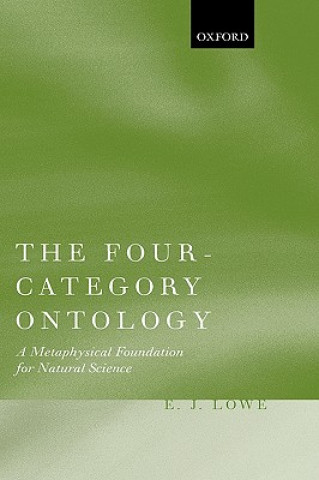
Książka Four-Category Ontology E. J. Lowe

Four-Category Ontology

A Metaphysical Foundation for Natural Science

Autor: E. J. Lowe
Język: Angielski
Oprawa: Twarda
Dostępność: Dostępna u dostawcy
Wysyłamy za 10-18 dni
516.89
E. J. Lowe sets out and defends his theory of what there is. His four-category ontology is a metaphy...
Informacje o książce

Autor
Język
Angielski
Oprawa
Książka - Twarda
Data wydania
2005
strony
240
EAN
9780199254392
ISBN
0199254397
Enbook ID
04530500
Waga
518
Wymiary
163 x 242 x 19

Pełny opis

E. J. Lowe sets out and defends his theory of what there is. His four-category ontology is a metaphysical system that recognizes two fundamental categorial distinctions which cut across each other to generate four fundamental ontological categories. The distinctions are between the particular and the universal and between the substantial and the non-substantial. The four categories thus generated are substantial particulars, non-substantial particulars, substantial universals and non-substantial universals. Non-substantial universals include properties and relations, conceived as universals. Non-substantial particulars include property-instances and relation-instances, otherwise known as non-relational and relational tropes or modes. Substantial particulars include propertied individuals, the paradigm examples of which are persisting, concrete objects. Substantial universals are otherwise known as substantial kinds and include as paradigm examples natural kinds of persisting objects. This ontology has a lengthy pedigree, many commentators attributing it to Aristotle on the basis of certain passages in his apparently early work, the Categories. At various times during the history of Western philosophy, it has been revived or rediscovered, but it has never found universal favour, perhaps on account of its apparent lack of parsimony as well as its commitment to universals. In pursuit of ontological economy, metaphysicians have generally preferred to recognize fewer than four fundamental ontological categories. However, Occam's razor stipulates only that we should not multiply entities beyond necessity; Lowe argues that the four-category ontology has an explanatory power unrivalled by more parsimonious systems, and that this counts decisively in its favour. He shows that it provides a powerful explanatory framework for a unified account of causation, dispositions, natural laws, natural necessity and many other related matters, such as the semantics of counterfactual conditionals and the character of the truthmaking relation. As such, it constitutes a thoroughgoing metaphysical foundation for natural science.

Możesz być zainteresowany

454.65
124.97

Time for Kids: Big Book of How

Editors of TIME for Kids Magazine
71.17

Molecular Tactics of a Crystal

William Thomson Kelvin
124.77
87.35
50.42

Going Public

Elizabeth Miller
438.86
50.02
141.05
196.35
150.09
66.20

Yankee Girls in Zulu Land

Louise Vescelius Sheldon
63.72

Klienci, którzy kupili tę książkę, kupili również

251.44

Novgorod.

Jörg Leuschner
145.32
37.81

Das Stunden-Buch

Rainer Maria Rilke
34.63

Dragon Ball 15

Akira Toriyama
54.19

Pippi Dlhá Pančucha

Astrid Lindgrenová
50.42