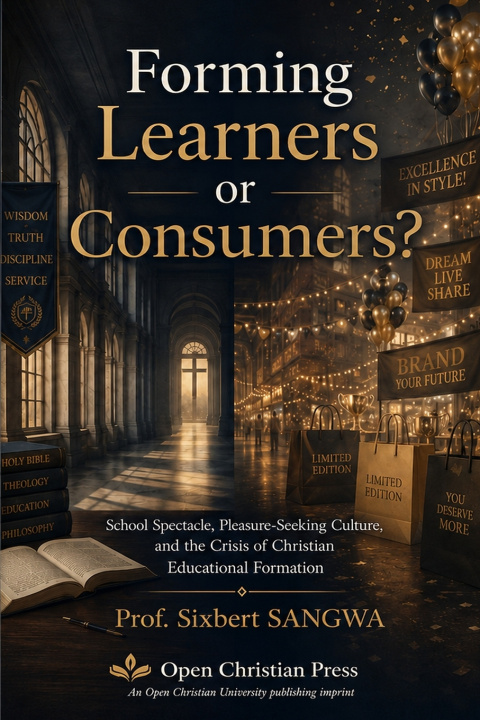
What kind of children are our schools really forming?
Across many schools today, education is increasingly surrounded by ceremonies, themed events, costly study tours, branded experiences, social-media display, and compulsory extras. Many of these activities appear harmless, enjoyable, or even educational. Yet repeated practices quietly teach children what to love, what to admire, what to expect, and what to associate with success, belonging, and joy.
Forming Learners or Consumers? offers a serious Christian critique of this growing school culture. Prof. Sixbert SANGWA examines how ordinary educational practices can train children toward consumption, performance, comparison, pleasure-seeking, and dependence on spectacle rather than wisdom, discipline, stewardship, service, and truthful purpose before God.
This book does not attack teachers, parents, or schools. It affirms joyful learning, meaningful field experiences, ceremony, play, and community when they are purposeful, proportionate, and curriculum-aligned. Its concern is with excess, misnaming, financial pressure, weak educational justification, ceremonial inflation, and the subtle weakening of parental authority.
Drawing from biblical theology, educational philosophy, curriculum theory, consumer-culture critique, child formation, and policy analysis, the book asks hard but necessary questions: Are school activities truly educational or merely entertaining? Are children being formed as image-bearers or as consumers? Are parents respected as partners or treated mainly as financiers? Are Christian schools resisting the spirit of the age or simply baptizing it with religious language?
Practical and pastoral, this book includes guidance for parents, school leaders, church boards, and Christian educators, along with policy tools for evaluating ceremonies, study tours, compulsory extras, opt-out protections, and curriculum alignment.
For readers concerned about Christian education, school culture, parenting, educational stewardship, and the moral formation of children, this book is a timely call to recover education that forms learners for wisdom, purpose, service, and joy before God.