Książka Formal Methods for Components and Objects Bernhard K. Aichernig

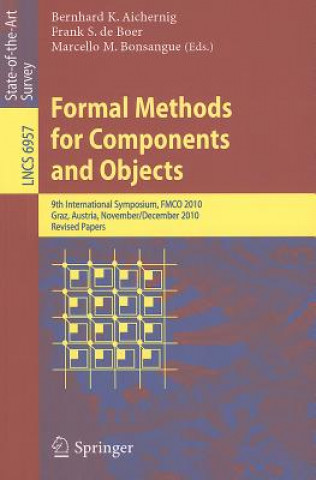
Formal Methods for Components and Objects

9th International Symposium, FMCO 2010, Graz, Austria, November 29 - December 1, 2010

Język: Angielski
Oprawa: Miękka
Dostępność: Dostępna u dostawcy
Wysyłamy za 9-15 dni
240.61
The focus in development methodologies of large and complex software systems has switched in the las...
Informacje o książce

Język
Angielski
Oprawa
Książka - Miękka
Data wydania
2011
strony
393
EAN
9783642252709
ISBN
3642252702
Enbook ID
01659244
Waga
607
Wymiary
155 x 235 x 25

Pełny opis

The focus in development methodologies of large and complex software systems has switched in the last two decades from functional issues to structural issues; this holds for both the object-oriented and the more recent component-based software engineering paradigms. Formal methods have been applied successfully to the verification of medium-sized programs in protocol and hardware design for quite a long time. However, their application to the development of large systems requires more emphasis on specification, modeling and validation techniques supporting the concepts of reusability and modifiability, and their implementation in new extensions of existing programming languages like Java. This state-of-the-art survey presents the outcome of the 9th Symposium on Formal Methods for Components and Objects, held in Graz, Austria, in November/December 2010. The volume contains 20 revised contributions submitted after the symposium by speakers from each of the following European IST projects: the FP7-IST project AVANTSSAR on automated validation of trust and security of service-oriented architectures; the FP7-IST project DEPLOY on industrial deployment of advanced system engineering methods for high productivity and dependability; the ESF-COST Action IC0701 on formal verification of object-oriented software; the FP7-IST project HATS on highly adaptable and trustworthy software using formal models; the FP7-SST project INESS on an integrated European railway signalling system; the FP7-IST project MADES on a model-driven approach to improve the current practice in the development of embedded systems; the FP7-IST project MOGENTES on model-based generation of tests for dependable embedded systems; as well as the FP7-IST project MULTIFORM on integrated multi-formalism tool support for the design of networked embedded control systems.

Możesz być zainteresowany

Distributed Algorithms

Jean-Claude Bermond
212.13

Family Romance

John Lanchester
65.81

Amarillo

Paul H. Carlson
107.22

Freedom in the World: 2000-2001

Freedom House Survey Team
480.06
964.91
300.40
101.10

Metabolic Syndrome

Akhlaq A. Farooqui
844.55

Pilgrimage

Diana Davidson
91.47

Byzantium for Rome

Richard Drake
219.42
53.65

Growing Economy

J. E. Meade
858.54

Junior Reading Books, Vol. 4

Jane M Howard Turner
71.93

Little Battles

Ron Emrick
103.04
91.96

Rambles And Musings (1886)

John Rowell Waller
98.77
37.52

Klienci, którzy kupili tę książkę, kupili również

309.54
88.27
46.66

Vulnerabilidad

Miquel Seguro
49.86

Krankenhausmanagement 2000

Uschi Backes-Gellner
213.10
16.42
67.85

GewO

Josef Unterweger
209.40
208.04