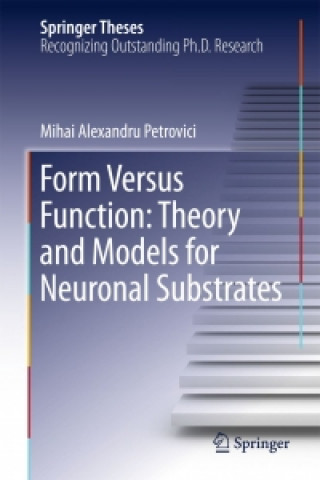
Książka Form Versus Function: Theory and Models for Neuronal Substrates Mihai Alexandru Petrovici

Form Versus Function: Theory and Models for Neuronal Substrates

Język: Angielski
Oprawa: Twarda
Dostępność: Dostępna u dostawcy w małych ilościach
Wysyłamy za 11-15 dni
472.40
This thesis addresses one of the most fundamental challenges for modern science: how can the brain a...


Informacje o książce

Język
Angielski
Oprawa
Książka - Twarda
Data wydania
2016
strony
374
EAN
9783319395517
ISBN
3319395513
Enbook ID
02991846
Waga
7214
Wymiary
155 x 235 x 28

Pełny opis

This thesis addresses one of the most fundamental challenges for modern science: how can the brain as a network of neurons process information, how can it create and store internal models of our world, and how can it infer conclusions from ambiguous data? The author addresses these questions with the rigorous language of mathematics and theoretical physics, an approach that requires a high degree of abstraction to transfer results of wet lab biology to formal models. The thesis starts with an in-depth description of the state-of-the-art in theoretical neuroscience, which it subsequently uses as a basis to develop several new and original ideas. Throughout the text, the author connects the form and function of neuronal networks. This is done in order to achieve functional performance of biological brains by transferring their form to synthetic electronics substrates, an approach referred to as neuromorphic computing. The obvious aspect that this transfer can never be perfect but necessarily leads to performance differences is substantiated and explored in detail. The author also introduces a novel interpretation of the firing activity of neurons. He proposes a probabilistic interpretation of this activity and shows by means of formal derivations that stochastic neurons can sample from internally stored probability distributions. This is corroborated by the author's recent findings, which confirm that biological features like the high conductance state of networks enable this mechanism. The author goes on to show that neural sampling can be implemented on synthetic neuromorphic circuits, paving the way for future applications in machine learning and cognitive computing, for example as energy-efficient implementations of deep learning networks. The thesis offers an essential resource for newcomers to the field and an inspiration for scientists working in theoretical neuroscience and the future of computing. §
Możesz być zainteresowany

Pyrite

David Rickard
156.64

Stand Up for Jesus!

Dudley Atkins Tyng
122.76

21 donne nere eccezionali

STUDENT PRESS BOOKS
46.87
74.80

Hatchet

Gary Paulsen
28.12
30.17

On Growth and Form

D'Arcy Wentworth Thompson
64.06
213.09
61.23
72.26

Manipulated Man

Esther Vilar
52.83
1 093.93

Klienci, którzy kupili tę książkę, kupili również

Alcools

Guillaume Apollinaire
33.39

Netvor

L. J. Shen
70.41
93.94

Jan Žižka

Petr Čornej
106.35
69.72
121.58

Mikuláš Puchník

Dominik Budský
38.47
68.16

Phantomschmerz

Arnon Grünberg
57.12

MAGIE

Josef Veselý
67.28