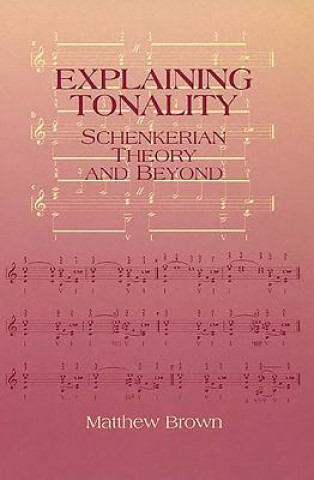
Książka Explaining Tonality Matthew Brown

Explaining Tonality

Schenkerian Theory and Beyond

Autor: Matthew Brown
Język: Angielski
Oprawa: Twarda
Dostępność: Dostępna u dostawcy
Wysyłamy za 9-15 dni
585.16
A wide range of music - from Bach to Mozart and Brahms - is marked by its use of some form of what i...


Informacje o książce

Język
Angielski
Oprawa
Książka - Twarda
Data wydania
2005
strony
315
EAN
9781580461603
ISBN
1580461603
Enbook ID
04822602
Waga
652
Wymiary
166 x 234 x 26

Pełny opis

A wide range of music - from Bach to Mozart and Brahms - is marked by its use of some form of what is generally called "tonality": the tendency of music to focus melodically on some stable pitch or tonic and for its harmony to use functional triads. Yet, few terms in music theory are more enigmatic than that seemingly simple word "tonality." Matthew Brown's "Explaining Tonality: Schenkerian Theory and Beyond" considers a number of disparate ways in which functional tonality has been understood. In particular, it focuses on the comprehensive theory developed by Heinrich Schenker in his monumental three-part treatise Neue musikalische Theorien und Phantasien (1906-35). Schenker systematically investigated the ways in which lines and chords behave both locally within individual tonal phrases and globally across entire compositions."Explaining Tonality" shows why Schenker was able to elucidate tonal relationships so successfully and the many advantages that his explanations have over those of his rivals. In addition, it proposes some ways in which Schenker's approach can be extended to tonal features in works from before Bach (such as "Monteverdi") and after Brahms (such as Debussy, Stravinsky, and much popular music of today).Along the way, the book explores six methodological criteria that help in building, testing, and evaluating a plausible theory of tonality or, indeed, any other musical phenomenon: accuracy, scope, fruitfulness, consistency, simplicity, and coherence. It reveals how understanding the tonality of a piece can shed light on other aspects of musical composition. And, in conclusion, it describes some ways in which Schenkerian theory might fruitfully develop in the future. Matthew Brown is Professor of Music Theory at the Eastman School of Music, University of Rochester, and author of "Debussy's "Iberia"" (Oxford University Press).

Możesz być zainteresowany

The Crippled Angel

Sara Douglass
61.72

Moo!

David Larochelle
36.84

Hitler Youth

Brenda Ralph Lewis
82.82

Aerocapture Systems Analysis for a Neptune Mission

National Aeronautics and Administration
86.91

No Judgments

CABOT MEG
67.17
296.12
78.54
248.97

MY PASSION FOR DESIGN

STREISAND BARBRA
309.83
98.09

Adaptive Herbivore Ecology

R. Norman Owen-Smith
262.68

Children, Families, and Government

Edward F. ZiglerSharon Lynn KaganNancy W. HallJohn Brademas
690.16

Let's Do Theology

Laurie Green
94.20
145.72

Indoor Air Pollution

John D. Spengler
197.35

Metal Shredders

Nancy Zafris
58.71
38.49

Klienci, którzy kupili tę książkę, kupili również

591.58

Modal Counterpoint

Peter Schubert
259.28
424.26
547.44
190.06

Analysis of Tonal Music

Allen Cadwallader
591.58
156.61

Fleurs d'Avril

SANS AUTEUR
56.18

Lasswell-Formel

Sebastian Hoos
59.20

Osmanisch, Lehrbuch

Korkut Bugday
190.25
69.89

Sakli Bahce Aile

Ravza Zeybek
58.23
102.85

Astillero

Juan Carlos Onetti
60.07
106.74