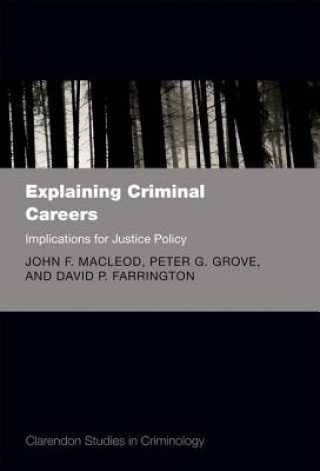
Książka Explaining Criminal Careers John F. MacLeod

Explaining Criminal Careers

Implications for Justice Policy

Język: Angielski
Oprawa: Twarda
Dostępność: Dostępna u dostawcy
Wysyłamy za 10-18 dni
478.34
A PDF version of this book is available for free in open access via www.oup.com/uk as well as the O...


Informacje o książce

Język
Angielski
Oprawa
Książka - Twarda
Data wydania
2012
strony
274
EAN
9780199697243
ISBN
0199697248
Enbook ID
04535045
Waga
460
Wymiary
146 x 220 x 21

Pełny opis

A PDF version of this book is available for free in open access via www.oup.com/uk as well as the OAPEN Library platform, www.oapen.org. It has been made available under a Creative Commons Attribution-Non Commercial-No Derivatives 3.0 license and is part of the OAPEN-UK research project. Explaining Criminal Careers presents a simple but influential theory of crime, conviction and reconviction. The assumptions of the theory are derived directly from a detailed analysis of cohort samples extracted from the Home Office Offenders Index - a unique database which contains records of all criminal (standard list) convictions in England and Wales since 1963. In particular, the theory explains the well-known Age/Crime curve. Based on the idea that there are only three types of offenders, who commit crimes at either high or low (constant) rates and have either a high or low (constant) risk of reoffending, this simple theory makes exact quantitative predictions about criminal careers and age-crime curves. Purely from the birth-rate over the second part of the 20th century, the theory accurately predicts (to within 2%) the prison population contingent on a given sentencing policy. The theory also suggests that increasing the probability of conviction after each offence is the most effective way of reducing crime, although there is a role for treatment programmes for some offenders. The authors indicate that crime is influenced by the operation of the Criminal Justice System and that offenders do not 'grow out' of crime as commonly supposed; they are persuaded to stop or decide to stop after (repeated) convictions, with a certain fraction of offenders desisting after each conviction. Simply imprisoning offenders will not reduce crime either by individual deterrence or by incapacitation. With comprehensive explanations of the formulae used and complete mathematical appendices allowing for individual interpretations and further development of the theory, Explaining Criminal Careers represents an innovative and meticulous investigation into criminal activity and the influences behind it. With clear policy implications and a wealth of original and significant discussions, this book marks a ground-breaking chapter in the criminological debate surrounding criminal careers.

Możesz być zainteresowany

156.98
44.82

Village Scandal

Dilly Court
44.82

Pulp

BRUBAKER ED
48.55

Naked Prince

BEN GREER
76.37

Photovoltaic Systems

Yaman Abou Jieb
251.55
59.36
768.73

Five Faces of Exile

Augusto Fauni Espiritu
111.66

Molecular Physics

Theodore Buyana
594.24

Wall Street

Walter Werner
710.34

Klienci, którzy kupili tę książkę, kupili również

23.48

Las Orejas (Ears)

Jenna Lee Gleisner
132.50
53.17