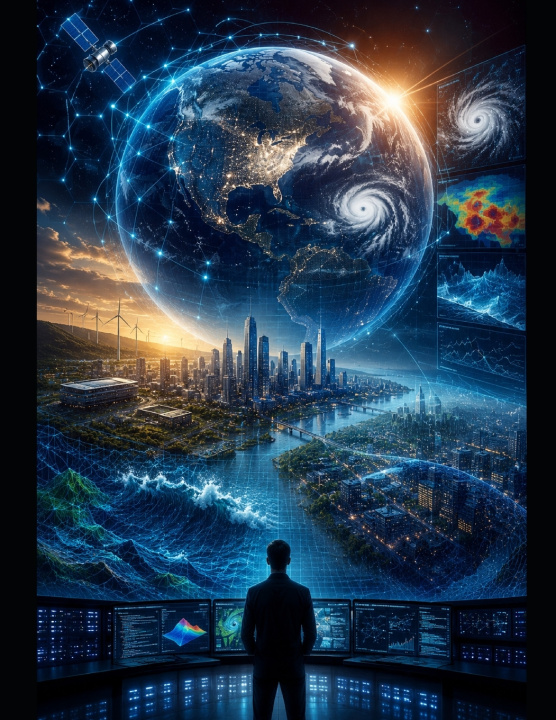
What if a machine could learn the laws of nature?
As simulations grow larger, faster, and more complex, a new frontier is emerging where artificial intelligence and scientific computing converge. Digital Twins are no longer limited to modeling the present-they are beginning to anticipate the future.
In this second volume of the Synthetic Reality Series, readers journey beyond traditional simulation and into the world of intelligent prediction. Here, machine learning, uncertainty quantification, data assimilation, and exascale computing combine to create systems capable of forecasting events before they unfold.
Inside, you will explore:
Scientific Machine Learning and AI Surrogates
Fourier Neural Operators and Neural Physics Models
Ensemble Forecasting and Probabilistic Prediction
Non-Linearity, Chaos, and the Lyapunov Horizon
Data Assimilation, Kalman Filters, and 4D-Var Systems
Stochastic Perturbation and Uncertainty Quantification
Climate AI and Planetary-Scale Simulation
Digital Twin Intelligence Architectures
Real-Time Prediction at Exascale Scale
Bridging the gap between traditional scientific computing and modern artificial intelligence, this volume reveals how next-generation Digital Twins learn, adapt, and predict.
As humanity confronts increasingly complex challenges-from climate instability and infrastructure stress to disaster forecasting and resource management-the ability to anticipate future states is becoming one of the most powerful capabilities ever developed.
The future is not a fixed destination.
It is a probability distribution.
And those who understand it will help shape it.
Welcome to the Intelligence Layer.
Welcome to the age of Predictive Reality.