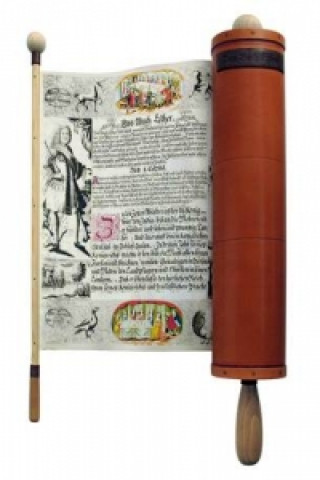
This is a rare occasion to own your own facsimile of a legendary Old Testament scroll. The use of scrolls dates back to ancient history. Bearing written texts, rolls of papyrus or parchment dealing with matters from all spheres of life-private, religious, administrative, legal, and political-were already in use as long ago as Ancient Egypt. One of the most well-known scrolls in history is the Esther scroll, or Hebrew megillah, which is devoted solely to the story of Queen Esther and is read on the feast of Purim. An uninhibitedly joyful festival, Purim celebrates the salvation of the Jews in the Persian empire of the 5th century under the rule of King Xerxes I. The word Purim is derived from the Hebrew "pur," meaning "lot," and refers to the fact that the Persian minister Haman determined by lot the time that all Jews should be destroyed. This circumstance, related in the Hebrew Bible's "Book of Esther", is publicly read out from the megillah in the synagogue at Purim. The "Esther" scroll in the Gottfried Wilhelm Leibniz Library in Hanover, dated 1746 and measuring 6.5 meters long, is a very fine and rare example and serves as the original from which TASCHEN's exacting facsimile is produced; this particular megillah is unique not only in terms of its lavish illuminations but also because it contains a Christian biblical text in the German language.
Scrolls used in synagogues are not adorned with decorative elements, therefore this very elaborately and beautifully adorned specimen was clearly destined for private use. For many centuries, the creator of the Hanover scroll was unknown. Piecing together information from various sources, and performing his own stylistic analysis of this and other works of art from the period, author Falk Wiesemann recently made an enthralling discovery: the artist of the "Hanover" scroll was Wolf Leib Katz Poppers, a Jewish scribe and illustrator from Hildesheim. TASCHEN's facsimile of the scroll - a major achievement in publishing history - is accompanied by a commentary volume which emphasizes the literary quality of the biblical "Book of Esther", its importance for the Purim festival, and its significance for Jewish art, leaving the reader with an understanding and appreciation of the artistic quality and cultural background of the megillah. It is a limited edition facsimile scroll. It is a richly illustrated, continuous text, 6.5 m (over 21 ft) long, unfurls from left to right like antique rotuli.
This companion volume in a protective slipcase contains the biblical text of the "Book of Esther" in three languages and a fold-out sheet providing an overview of all the illustrations.