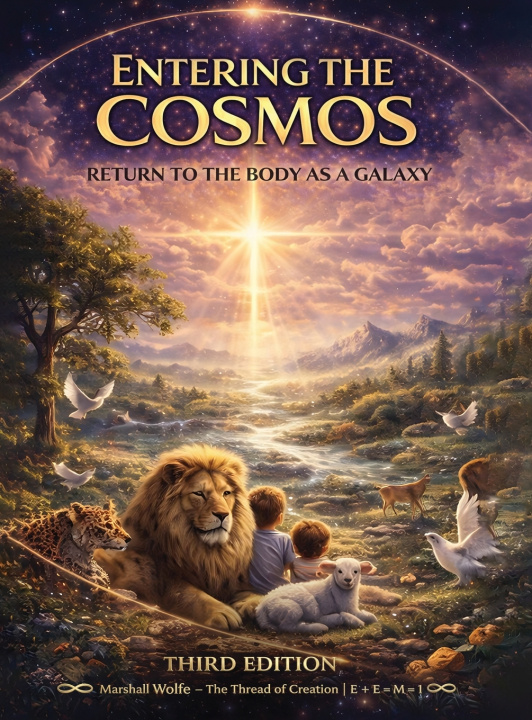
This book is for the people.
It is for the reader who has suffered, the family member who has worried, the seeker who has questioned, the believer who has prayed, the skeptic who has doubted, and the thinker who has looked at the human body and felt that there must be more to life than a collection of separate parts. It is also for the physician, the scientist, the philosopher, the mathematician, the physicist, and the astrophysicist - for anyone willing to look at the body and the universe with fresh eyes and with honest curiosity.
COSMOS was born from one central conviction: that the human body can be understood not only as anatomy, chemistry, and mechanics, but also as a living unity - a field of order, motion, rhythm, resonance, and energy. In these pages, I ask the reader to consider the body as a kind of galaxy: not chaotic, not meaningless, but organized; not dead matter, but a living arrangement of relationships, signals, forces, and patterns. In that sense, this book is both personal and universal. It is personal because it comes from years of reflection, struggle, observation, faith, and persistence. It is universal because every human being lives inside a body, and every body is part of a greater creation.
This work is written in a spirit of harmony. It is not meant to divide people by race, religion, culture, education, profession, or belief. It is meant to open a door. Whether you come to these pages as a person of faith, a non-believer, a doctor, an artist, a patient, an engineer, or an astrophysicist who studies stars and structure on the largest scale, you are welcome here. My hope is that COSMOS speaks to both the heart and the mind - to compassion and to inquiry - and that it encourages a wider conversation about what life is, how the body holds together, and what healing may truly mean.
I do not offer this book as a replacement for medical care, diagnosis, or treatment. I offer it as a theory, a framework, and an invitation. It is an attempt to express a deeper pattern I believe is worth examining: that the body may function as a unified energetic whole, and that understanding this unity may help us think differently about health, disease, disorder, restoration, and human potential. If this work inspires research, discussion, reflection, or a more humane way of looking at the body, then it has already begun to do its job.
To the reader, I ask only this: read with patience, courage, and an open mind. Read as a person standing between the microscopic and the cosmic. Read as someone who knows that the same creation that stretches across the heavens also lives in breath, pulse, memory, rhythm, and flesh. If the universe can hold order among stars, perhaps there is also an order within us that we have not yet fully learned to name.
That is the spirit of COSMOS.
It is a book of questions, of vision, of healing, of wonder, and of unity.
It is written for the people.
And it is written in the hope that one day the distance between the human body and the universe will be understood not as a separation, but as a thread.