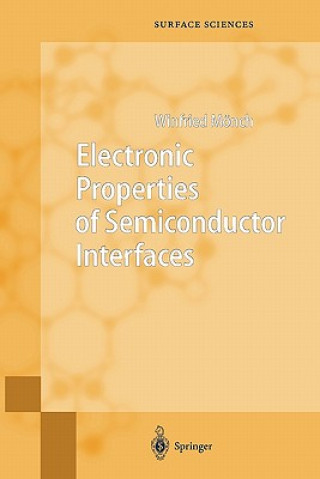
Książka Electronic Properties of Semiconductor Interfaces Winfried Mönch

Electronic Properties of Semiconductor Interfaces

Język: Angielski
Oprawa: Miękka
Dostępność: Dostępna u dostawcy
Wysyłamy za 5-8 dni
940.09
Almost all semiconductor devices contain metal-semiconductor, insulator-semiconductor, insulator-met...


Informacje o książce

Język
Angielski
Oprawa
Książka - Miękka
Data wydania
2010
strony
264
EAN
9783642057786
ISBN
3642057780
Enbook ID
01651114
Waga
433
Wymiary
155 x 235 x 16

Pełny opis

Almost all semiconductor devices contain metal-semiconductor, insulator-semiconductor, insulator-metal and/or semiconductor-semiconductor interfaces; and their electronic properties determine the device characteristics. This is the first monograph that treats the electronic properties of all different types of semiconductor interfaces. Using the continuum of interface induced gap states (IFIGS) as the unifying concept, Mönch explains the band-structure lineup at all types of semiconductor interfaces. These intrinsic IFIGS are the wave-function tails of electron states, which overlap a semiconductor band-gap exactly at the interface, so they originate from the quantum-mechanical tunnel effect. He shows that a more chemical view relates the IFIGS to the partial ionic character of the covalent interface-bonds and that the charge transfer across the interface may be modeled by generalizing Pauling s electronegativity concept. The IFIGS-and-electronegativity theory is used to quantitatively explain the barrier heights and band offsets of well-characterized Schottky contacts and semiconductor heterostructures, respectively.Using the continuum of interface-induced gap states (IFIGS) as a unifying theme, Mönch explains the band-structure lineup at all types of semiconductor interfaces. These intrinsic IFIGS are the wave-function tails of electron states, which overlap a semiconductor band-gap exactly at the interface, so they originate from the quantum-mechanical tunnel effect. He shows that a more chemical view relates the IFIGS to the partial ionic character of the covalent interface-bonds and that the charge transfer across the interface may be modeled by generalizing Pauling?s electronegativity concept. The IFIGS-and-electronegativity theory is used to quantitatively explain the barrier heights and band offsets of well-characterized Schottky contacts and semiconductor heterostructures, respectively.Almost all semiconductor devices contain metal-semiconductor, insulator-semiconductor, insulator-metal and/or semiconductor-semiconductor interfaces; and their electronic properties determine the device characteristics. This is the first monograph that treats the electronic properties of all different types of semiconductor interfaces. Using the continuum of interface induced gap states (IFIGS) as a unifying theme, Mönch explains the band-structure lineup at all types of semiconductor interfaces. These intrinsic IFIGS are the wave-function tails of electron states, which overlap a semiconductor band-gap exactly at the interface, so they originate from the quantum-mechanical tunnel effect. He shows that a more chemical view relates the IFIGS to the partial ionic character of the covalent interface-bonds and that the charge transfer across the interface may be modeled by generalizing Pauling s electronegativity concept. The IFIGS-and-electronegativity theory is used to quantitatively explain the barrier heights and band offsets of well-characterized Schottky contacts and semiconductor heterostructures, respectively.

Możesz być zainteresowany

Dynamical Systems VII

Vladimir I. Arnold
428.07
71.24
49.29
39.16

Industry 4.0 for SMEs

Dominik T. Matt
124.68
28.14

Wes Lang: The Black Paintings

Wes; Fox James & Ludel Wallace Lang
309.68
149.96
57.17
545.57

Klienci, którzy kupili tę książkę, kupili również

92.89

Na kopci za dedinou

Elena Krásnohorská
50.97
91.21

Farben der Schuld

Gisa Klönne
66.61

La piazza

Tommaso Bucciarelli
18.20
94.86

Belleville

Thierry Gallier
68.38

Lexicon Platonicum

Friedrich Ast
319.52
103.42
111.29

Manifest čtyř

Jiří Hanuš
28.04

El laberinto griego

Manuel Vázquez Montalbán
73.89