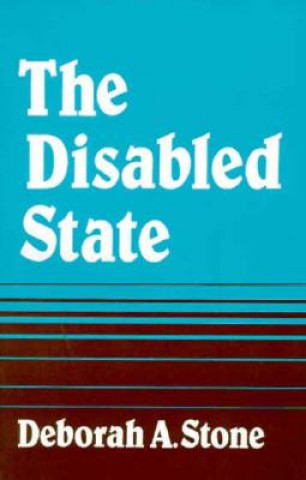
Książka Disabled State Deborah A. Stone

Disabled State

Język: Angielski
Oprawa: Miękka
Dostępność: 50 % szansa
Przeszukamy cały świat
148.28
This is a book about the defining assumptions and assumed definition of the welfare state. It is a w...


Informacje o książce

Język
Angielski
Oprawa
Książka - Miękka
Data wydania
1986
strony
256
EAN
9780877223627
ISBN
0877223629
Enbook ID
04946252
Waga
350
Wymiary
209 x 141 x 31

Pełny opis

This is a book about the defining assumptions and assumed definition of the welfare state. It is a work that pulls apart social categories like "disability" or "need" and shows how they function politically and where they come from historically. For many years, the welfare state was expanding. In those times, advocates for many new groups of people were able to win through the political process the extension of benefits to their constituents. Definitions of need, worth, and eligibility were changed so that more people became "entitled" to payments. The opposite trend is in effect now. Most advanced industrial states have experienced some form of fiscal crisis, and their governments are taking a hard look at how they define who is eligible for support. One major category is disability. But who is "disabled," and who decides that? Though doctors certify disability for the state, Stone argues that "the concept of disability is fundamentally the result of political conflict about distributive criteria and the appropriate recipients of social aid." The concept also has a social history and a social context today. Despite the very real stigma of the world "disabled" in other settings, being "disabled" for welfare purposes means being morally worthy. Like the "deserving poor" of English Poor Law, the "disabled" would work if they could. Isn't disability something that can be measured scientifically and apolitically determined? That argument breaks down in the face of a simple example: blindness. Many blind people can work, yet because of the obviousness of the condition and sympathy it arouses, the "blind" have always been considered eligible for benefits without question. The concern with "welfare cheats" is not a new one. The author reaches back several centuries to trace the fascinating history of this and other aspects of welfare policy in Germany, England, and the United States. What she finds are elaborate tests to weed out fraudulent applicants (beggars with faked afflictions) and changing criteria to distinguish the able from the "disabled." Author note: Deborah A. Stone is Associate Professor of Political Science a the Massachusetts Institute of Technology. She is author of The Limits of Professional Power: National Health Care in the Federal Republic of Germany.

Możesz być zainteresowany

Roswell

John LeMay
86.11

TITO's JASENOVAC

Mladen Ivezic
91.48

London Coven

M V Stott
68.71

With Fire and Sword

Major S. H. M. Byers
74.08

Japanese Garden Notes

Marc Peter Keane
235.77

Self-Love

DR. KATHERINE JAMES
104.29
174.57

Carlinville

Louise M. Jett
86.11

Just Do Something

Kevin Deyoung
43.98

Psychological First Aid

World Health Organization
60.40
60.20
94.71

Betwixt Two Lovers. a Novel.

Gawin William Rowan Hamilton
79.46
220.61

Klienci, którzy kupili tę książkę, kupili również

Helmut Schmidt - Momente

Sven Felix Kellerhoff
87.18

Les Choses comme je les vois

Farooki roopa/oriol jeremy
52.68
97.06
107.12
206.24