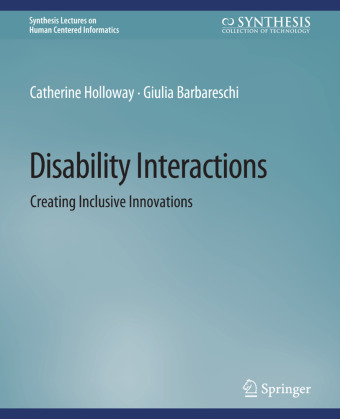
Książka Disability Interactions Catherine Holloway

Disability Interactions

Creating Inclusive Innovations

Język: Angielski
Oprawa: Miękka
Dostępność: Dostępna u dostawcy
Wysyłamy za 5-8 dni
249.13
Disability interactions (DIX) is a new approach to combining cross-disciplinary methods and theories...

Informacje o książce

Język
Angielski
Oprawa
Książka - Miękka
Data wydania
2021
strony
198
EAN
9783031037498
Enbook ID
39279726
Waga
423
Wymiary
191 x 235 x 13

Pełny opis

Disability interactions (DIX) is a new approach to combining cross-disciplinary methods and theories from Human Computer Interaction (HCI), disability studies, assistive technology, and social development to co-create new technologies, experiences, and ways of working with disabled people. DIX focuses on the interactions people have with their technologies and the interactions which result because of technology use. A central theme of the approach is to tackle complex issues where disability problems are part of a system that does not have a simple solution. Therefore, DIX pushes researchers and practitioners to take a challenge-based approach, which enables both applied and basic research to happen alongside one another. DIX complements other frameworks and approaches that have been developed within HCI research and beyond. Traditional accessibility approaches are likely to focus on specific aspects of technology design and use without considering how features of large-scale assistive technology systems might influence the experiences of people with disabilities. DIX aims to embrace complexity from the start, to better translate the work of accessibility and assistive technology research into the real world. DIX also has a stronger focus on user-centered and participatory approaches across the whole value chain of technology, ensuring we design with the full system of technology in mind (from conceptualization and development to large-scale distribution and access). DIX also helps to acknowledge that solutions and approaches are often non-binary and that technologies and interactions that deliver value to disabled people in one situation can become a hindrance in a different context. Therefore, it offers a more nuanced guide to designing within the disability space, which expands the more traditional problem-solving approaches to designing for accessibility. This book explores why such a novel approach is needed and gives case studies of applications highlighting how different areas of focus-from education to health to work to global development-can benefit from applying a DIX perspective. We conclude with some lessons learned and a look ahead to the next 60 years of DIX.

Możesz być zainteresowany

290.21
473.73
253.90
253.90

Disability and the Sociological Imagination

Allison C. (Shippensburg University of Pennsylvania) Carey
681.10
698.82
524.06
197.62
253.90
817.01

Signs of Disability

Stephanie L. Kerschbaum
158.20

Disability and Ageing

Ann (Maynooth University) Leahy
211.35
296.54

Klienci, którzy kupili tę książkę, kupili również

888.47
1 307.69

Accessible Atonement

David McLachlan
216.02
216.02
262.37
279.40

Life Worth Living

Joel Michael Reynolds
94.13
278.04

Work of Inclusion

Aana Marie Vigen
120.13