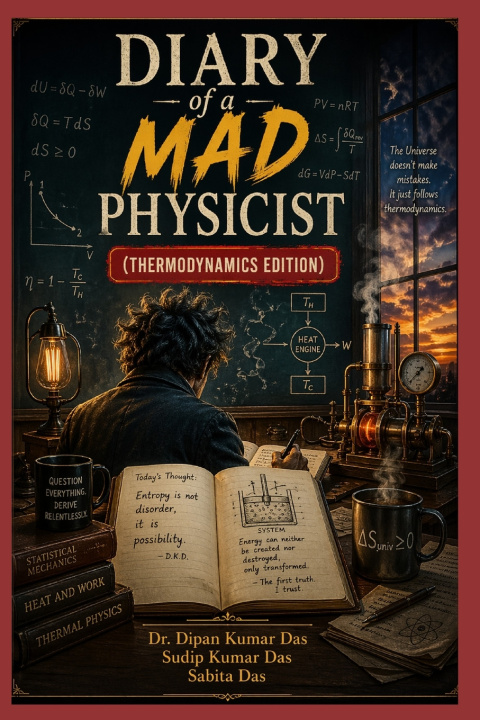
1: The Invitation to Heat World
Dr. Dipan never believed classrooms were enough. One evening, he gathered his students and handed them a strange invitation: a journey into the "Heat World." It was not metaphorical. Through a peculiar device, they would enter a realm where temperature, energy, and entropy ruled like natural laws made visible. The students were skeptical, but curiosity overpowered doubt.
2: The First Law Begins
Upon arrival, they found a bustling land where nothing was lost, only transformed. A burning forest fed rivers of motion, turning wheels and lifting stones. Dr. Dipan explained that energy here never disappeared; it merely changed form. The students saw heat becoming motion, motion becoming work, and work turning back into heat. Conservation was not an idea-it was the landscape itself.
3: Work and Heat as Travelers
In Heat World, heat and work were travelers carrying energy between places. Heat moved freely when temperatures differed, while work required deliberate effort. A giant engine demonstrated this: heat entered, work emerged, and some heat inevitably escaped. The students began to understand the difference not as definitions, but as experiences.
4: The Tyranny of Direction
They noticed something unsettling. Heat always flowed from hot to cold, never the reverse. Dr. Dipan introduced the idea of irreversibility. A shattered ice sculpture never reassembled itself. A spilled cup of tea never climbed back into the cup. The world had a preferred direction, and it was not negotiable.
5: Entropy's Silent Rule
At the center of Heat World stood a growing desert. It expanded slowly, consuming structured regions and turning them into disorder. This was entropy made visible. Dr. Dipan explained that entropy measured the spreading of energy. The students watched as organized systems gradually dissolved into randomness, understanding that disorder was not chaos, but probability unfolding.
6: Engines of Possibility
They visited a grand thermal engine city where machines tried to convert heat entirely into work. Every attempt failed. Some energy always slipped away as waste heat. Dr. Dipan revealed the limitation: no engine could be perfectly efficient. The students grasped that perfection was forbidden by nature itself.
7: The Ideal Illusion
In a quiet corner, they found a perfectly reversible engine. It operated infinitely slowly, producing no waste. Yet it was useless for practical work. Dr. Dipan smiled and explained that ideal systems often exist only as guides, not realities.
8: Temperature as a Language
The students encountered creatures who communicated using temperature differences. For them, temperature was not a number but a language of energy distribution. Hot regions spoke loudly, cold regions softly. The students began to see temperature as a measure of microscopic motion rather than mere sensation.
9: Statistical Secrets
Deep inside a crystalline cave, particles danced unpredictably. Dr. Dipan explained that thermodynamics was rooted in statistics. Large systems behaved predictably because countless random motions averaged out. The students realized that certainty emerges from uncertainty when numbers grow large.
10: Returning to Reality
The journey ended as suddenly as it began. Back in the classroom, everything looked ordinary again: a kettle boiling, a fan spinning, a cup cooling. But nothing felt ordinary. The students now saw invisible laws at work in every process.
11: Application and Understanding
Weeks later, the students applied what they learned. They designed efficient systems, predicted energy losses, and understood why certain processes could never be reversed. Thermodynamics was no longer abstract. Dr. Dipan closed his diary with a simple note:
"To understand heat is to understand limits, and within limits, possibility."