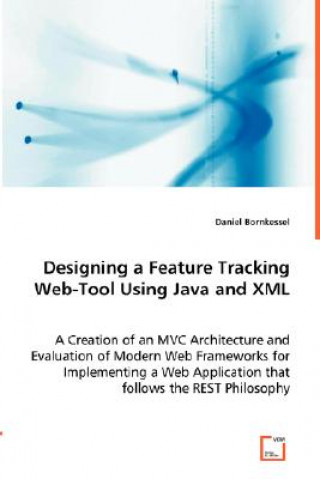
Książka Designing a Feature Tracking Web-Tool Using Java and XML Daniel Bornkessel

Designing a Feature Tracking Web-Tool Using Java and XML

A Creation of an MVC Architecture and Evaluation of Modern Web Frameworks for Implementing a Web Application that follows the REST Philosophy.

Język: Angielski
Oprawa: Miękka
Dostępność: Dostępna u dostawcy
Wysyłamy za 9-15 dni
211.36
§This book describes an architecture for a feature tracking tool. After an introduction to the proce...


Informacje o książce

Język
Angielski
Oprawa
Książka - Miękka
Data wydania
2008
strony
104
EAN
9783836472838
ISBN
383647283X
Enbook ID
06889929
Waga
150
Wymiary
152 x 229 x 6

Pełny opis

§This book describes an architecture for a feature tracking tool. After an introduction to the process of feature tracking, an overview of the implemented architecture and used technologies will be given. The system is realized as a server-client architecture exchanging XML messages via HTTP implemented in REST (Representational State Transfer). Persistent storage can be done on the server or on a client - each time using a native XML database. The server represents the central repository with which all clients synchronize their data. This document will show why this design and the technologies used represent an ideal solution for the problem.§The main focus of the book will be on a web client that was implemented as one possible front-end for the system. Possible technologies ranging from CGI to Model2 and popular frameworks for web applications, such as Struts and JavaServer Faces, will be discussed. Following this, an explanation of which solution was chosen and why it was chosen will be given. Several aspects of the system and the web client in particular will be discussed in detail before a reflection of the implemented components and an outlook will be given. pThis book describes an architecture for a feature tracking tool. After an introduction to the process of feature tracking, an overview of the implemented architecture and used technologies will be given. The system is realized as a server-client architecture exchanging XML messages via HTTP implemented in REST (Representational State Transfer). Persistent storage can be done on the server or on a client - each time using a native XML database. The server represents the central repository with which all clients synchronize their data. This document will show why this design and the technologies used represent an ideal solution for the problem./ppThe main focus of the book will be on a web client that was implemented as one possible front-end for the system. Possible technologies ranging from CGI to Model2 and popular frameworks for web applications, such as Struts and JavaServer Faces, will be discussed. Following this, an explanation of which solution was chosen and why it was chosen will be given. Several aspects of the system and the web client in particular will be discussed in detail before a reflection of the implemented components and an outlook will be given.

Możesz być zainteresowany

269.43

Italian Madrigal

Alfred Einstein
447.34
87.73
246.67
144.63
64.87

The Warrior

Christopher Clarey
65.55
262.14

Almost Life

Kiran Millwood Hargrave
44.44
328.18
210.88

Klienci, którzy kupili tę książkę, kupili również

24.60

Designer

Sibertin-Blanc
184.03
216.13

Ostrovy

Dora Kaprálová
39.68
33.74
131.40