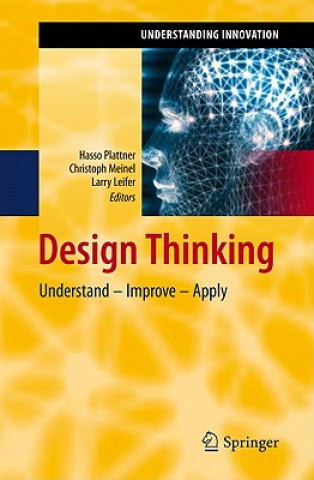
Książka Design Thinking Hasso Plattner

Design Thinking

Understand - Improve - Apply

Język: Angielski
Oprawa: Twarda
Dostępność: Dostępna u dostawcy
Wysyłamy za 10-18 dni
774.16
Everybody loves an innovation, an idea that sells. But how do we arrive at such ideas that sell? And...
Informacje o książce

Język
Angielski
Oprawa
Książka - Twarda
Data wydania
2010
strony
238
EAN
9783642137563
ISBN
3642137563
Enbook ID
01656060
Waga
560
Wymiary
166 x 243 x 21

Pełny opis

Everybody loves an innovation, an idea that sells. But how do we arrive at such ideas that sell? And is it possible to learn how to become an innovator? Over the years Design Thinking a program originally developed in the engineering department of Stanford University and offered by the two D-schools at the Hasso Plattner Institutes in Stanford and in Potsdam has proved to be really successful in educating innovators. It blends an end-user focus with multidisciplinary collaboration and iterative improvement to produce innovative products, systems, and services. Design Thinking creates a vibrant interactive environment that promotes learning through rapid conceptual prototyping. In 2008, the HPI-Stanford Design Thinking Research Program was initiated, a venture that encourages multidisciplinary teams to investigate various phenomena of innovation in its technical, business, and human aspects. The researchers are guided by two general questions:§1. What are people really thinking and doing when they are engaged in creative design innova-tion? How can new frameworks, tools, systems, and methods augment, capture, and reuse successful practices?§2. What is the impact on technology, business, and human performance when design thinking is practiced? How do the tools, systems, and methods really work to get the innovation you want when you want it? How do they fail?§In this book, the researchers take a system s view that begins with a demand for deep, evidence-based understanding of design thinking phenomena. They continue with an exploration of tools which can help improve the adaptive expertise needed for design thinking. The final part of the book concerns design thinking in information technology and its relevance for business process modeling and agile software development, i.e. real world creation and deployment of products, services, and enterprise systems.

Możesz być zainteresowany

633.67
93.52

Design Thinking

Teun den Dekker
316.15
69.89

Design Thinking

Kaushik Kumar
709.31

Design Thinking

SANZO SCRIBNER WHE
254.51

Murder Most Immoral

Anthony Hulse
66.49

Hamptons

Lucas Hunt
88.95
176.64
42.28

Lay Morals And Other Papers

Robert Louis Stevenson
54.43

Miss Dexie

Stanford Eveleth
160.99
844.55
125.21
128.42

Reflection on Color

Carlos Cruz–diez
127.06

Klienci, którzy kupili tę książkę, kupili również

Design Thinking

Stefan Ponsold
70.28

Thinking Design

Horst W. J. Rittel
219.90

Design Thinking

Michael Lewrick
44.42
87.20

Gedachtes

Martin Heidegger
217.86

Дураков нет

Ричард Руссо
107.22