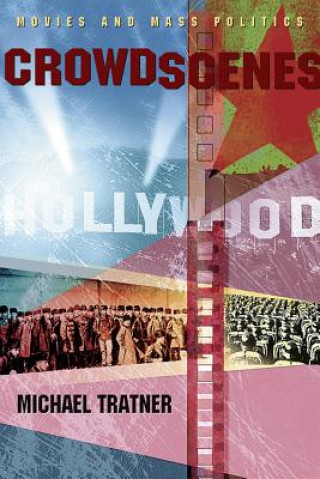
Książka Crowd Scenes Michael Tratner

Crowd Scenes

Movies and Mass Politics

Język: Angielski
Oprawa: Twarda
Dostępność: Dostępna u dostawcy
Wysyłamy za 9-15 dni
498.28
The movies and the masses erupted on the world stage together. In a few decades around the turn of t...


Informacje o książce

Język
Angielski
Oprawa
Książka - Twarda
Data wydania
2008
strony
162
EAN
9780823229017
ISBN
0823229017
Enbook ID
04940899
Waga
394
Wymiary
152 x 229 x 14

Pełny opis

The movies and the masses erupted on the world stage together. In a few decades around the turn of the twentieth century, millions of persons who rarely could afford a night at the theater and had never voted in an election became regular paying customers at movie palaces and proud members of new political parties. The question of how to represent these new masses fascinated and plagued politicians and filmmakers alike.Movies seemed to speak directly to the masses, via a form of crowd psychology that bypassed individual personality. Many political commentators believed that movies were inherently aligned with the new forms of collectivist mass politics - indeed, government control of the movie industry became a cornerstone of Communist and Fascist regimes, new political movements that embraced the crowd as the basis of social order.Michael Tratner examines the representations of masses - the crowd scenes - in Hollywood films from "The Birth of a Nation" through such popular love stories as "Gone with the Wind", "The Sound of Music", and "Dr. Zhivago". He then contrasts these with similar scenes in early Soviet and Nazi films. What emerges is a political debate being carried out in filmic style. In both sets of films, the crowd is represented as a seething cauldron of emotions. In Hollywood films, this is depicted as molding private loves, while collectivist movies present it as turning into organized mass movements. Crowd scenes do more than provide backgrounds for stories, that is: they also function as models for the crowd in the theater.The book concludes with an examination of the films of Fritz Lang, who first in pre-Nazi Germany, then in Hollywood, created movies that can be seen as meditations on both these ways of using the crowd.

Możesz być zainteresowany

43.94
109.08
41.60
579.63

Nobody

Louis Joseph Vance
33.39
76.56

Guys and Dolls

Damon Runyon
90.72

Lovestar, The

Anthony Armstrong
48.04
134.87

Branding New York

Miriam Greenberg
288.79

Rogue Forces

Dale Brown
35.93

Klienci, którzy kupili tę książkę, kupili również

91.01
165.53

Zero

Hemal Kothari
33.78

La Granja (Farm)

Pablo De La Vega
94.24