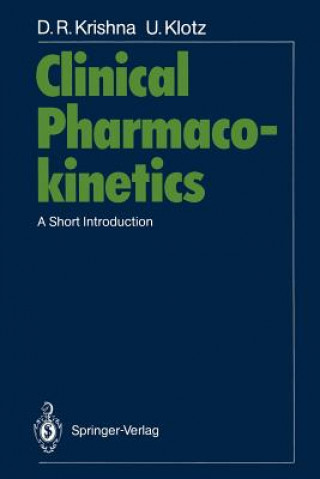
Książka Clinical Pharmacokinetics Devarakonda R. Krishna

Clinical Pharmacokinetics

A Short Introduction

Język: Angielski
Oprawa: Miękka
Dostępność: Dostępna u dostawcy
Wysyłamy za 5-8 dni
214.72
This basic introduction to pharmacokinetics is designed specifically for the young medical doctor. T...

Informacje o książce

Język
Angielski
Oprawa
Książka - Miękka
Data wydania
1990
strony
149
EAN
9783540524588
ISBN
3540524584
Enbook ID
06808221
Waga
248
Wymiary
236 x 155 x 6

Pełny opis

This basic introduction to pharmacokinetics is designed specifically for the young medical doctor. The text keeps the role of mathematical derivations to a minimum and brings the clinical importance of pharmacokinetics upstage. The first section of the book presents the basic principles of drug disposition, from absorption and distribution to elimination. Model problems and their solutions are presented in every chapter, and pathophysiological factors are also taken into consideration. The second section shows clinical applications, and how drug treatment and evaluation can be made more effective. The third section touches upon international nomenclature and includes numerous tables which can serve as quick and useful guidelines in clinical practice. §Das Buch schließt eine Lücke für Ärzte und Apotheker, die sich mit der Pharmakokinetik nur selten beschäftigen. The first part of this book enables the reader to be familiarized with basic concepts of pharmacokinetics (Absorption, Distribution, Metabolism and Excretion - ADM E) following single dose administration. In this part these principles are applied to clinically relevant situations, namely, multiple or (sub) chronic administration. In day to day practice besides acute drug response, often a longer duration of action is desired. This situation needs the under standing of changes in pharmacokinetics of drugs upon repeated administra tion, and the dosage regimen has to be accordingly adjusted for achieving uniform therapeutic levels for desired period of time. 2 Multiple dosing The basic mathematical relationships applicable to single dose administration kinetics are also valid (with slight modifications) for multiple dose kinetics. In multiple dose therapy the ultimate purpose is to achieve a steady drug effect or response with minimum side effects. As mentioned before, this can be achieved in most cases by maintaining the plasma concentrations in therapeutic range for required number of hours or days. This may be considered as a general rule with an exception of nitrates, in which case the concentrations during the interval between two doses (called "dosing interval") should fall below a critical threshold level, such that tolerance does not develop. A drug is commonly administered in fixed doses at constant intervals of time so that the amount lost through elimination is replaced after each dose.

Możesz być zainteresowany

Ego Is Not the Real You

David R. Hawkins
76.45
467.92
153.90

Expectation

Anna Hope
43.49

Promised Land

Barack Obama
172.40
1 389.42

Snowscape

Nicole Yen
115.92
48.80
71.24
317.46
42.90
428.07

Krondor: The Betrayal

Raymond E. Feist
49.29

Last And First Men

Olaf Stapledon
49.29
104.30

Klienci, którzy kupili tę książkę, kupili również

118.18

Rey, Constitución y política exterior

Miguel Fernández-Palacios M.
198.09
40.73

Atomové návyky

James Clear
65.63