For many amateur radio operators, the fascination begins with making contacts across towns, countries, or even continents. But sooner or later, every radio enthusiast encounters a deeper question: What is actually happening inside the equipment that makes all of this possible?
Understanding electronics is one of the most powerful skills a radio operator can develop. Yet many newcomers feel overwhelmed by technical jargon, complicated schematics, and mathematical explanations that seem disconnected from practical radio operation. The result is frustration, limited troubleshooting ability, and a dependence on others whenever equipment problems arise.
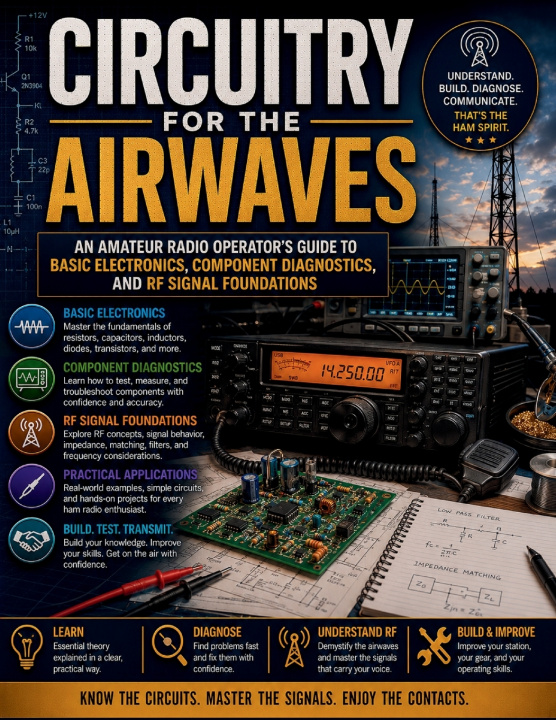
Circuitry for the Airwaves bridges the gap between amateur radio operation and practical electronics knowledge.
Written specifically for radio enthusiasts, this book provides a clear, approachable introduction to the electronic principles that form the foundation of radio communication. Instead of drowning readers in theory, it focuses on helping operators understand how circuits work, how components interact, how RF signals behave, and how to diagnose common equipment issues with confidence.
Whether you're newly licensed, returning to the hobby after years away, building your first station, experimenting with homebrew equipment, or simply seeking a stronger technical foundation, this guide will help you develop the knowledge needed to become a more capable and self-reliant operator.
You'll learn how electronic components function within real radio circuits, how signals are generated and processed, and how to identify common failures before they become major problems. By understanding what happens beneath the covers of your equipment, you'll gain confidence in troubleshooting, maintenance, upgrades, and station improvements.
Inside This Book, You'll Discover:
• The essential electronics concepts every radio operator should understand
• How resistors, capacitors, inductors, diodes, transistors, and integrated circuits function
• The fundamentals of voltage, current, resistance, and power
• Practical component testing and diagnostic techniques
• Common equipment failures and how to identify them
• Basic circuit analysis without unnecessary complexity
• RF signal behavior and propagation fundamentals
• Oscillators, filters, amplifiers, and frequency control systems
• Understanding signal paths inside radio equipment
• Multimeter usage and practical troubleshooting methods
• Safe testing procedures and maintenance practices
• How electronics knowledge improves operating success and station reliability
One of the most rewarding aspects of amateur radio is the ability to understand, modify, repair, and improve your own equipment. The operators who develop strong electronics skills often gain greater confidence, solve problems faster, and enjoy the hobby at a deeper level.
This book was designed to make that journey accessible.
Rather than memorizing formulas without context, you'll learn through practical explanations tied directly to radio applications. Every chapter helps connect electronic theory to real-world operating experiences, making technical concepts easier to understand and apply.
If you've ever wanted to move beyond simply using radio equipment and truly understand how it works, Circuitry for the Airwaves provides the foundation you've been looking for.
Build your electronics knowledge. Strengthen your troubleshooting skills. Understand RF signals with greater clarity. And become the kind of amateur radio operator who can confidently navigate both the airwaves and the circuitry behind them.