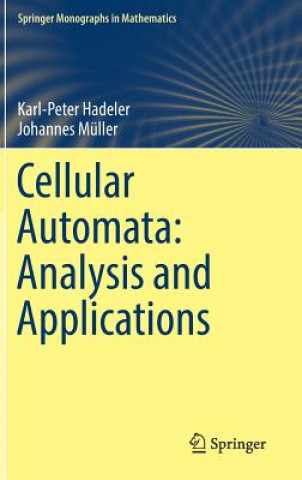
Książka Cellular Automata: Analysis and Applications Karl-Peter Hadeler

Cellular Automata: Analysis and Applications

Język: Angielski
Oprawa: Twarda
Dostępność: Dostępna u dostawcy
Wysyłamy za 10-18 dni
291.09
This book focuses on a coherent representation of the main approaches to analyze the dynamics of cel...

Informacje o książce

Język
Angielski
Oprawa
Książka - Twarda
Data wydania
2017
strony
467
EAN
9783319530420
ISBN
3319530429
Enbook ID
15690965
Waga
8395
Wymiary
155 x 235 x 32

Pełny opis

This book focuses on a coherent representation of the main approaches to analyze the dynamics of cellular automata. Cellular automata are an inevitable tool in mathematical modeling. In contrast to classical modeling approaches as partial differential equations, cellular automata are straightforward to simulate but hard to analyze. In this book we present a review of approaches and theories that allow the reader to understand the behavior of cellular automata beyond simulations. The first part consists of an introduction of cellular automata on Cayley graphs, and their characterization via the fundamental Cutis-Hedlund-Lyndon theorems in the context of different topological concepts (Cantor, Besicovitch and Weyl topology). The second part focuses on classification results: What classification follows from topological concepts (Hurley classification), Lyapunov stability (Gilman classification), and the theory of formal languages and grammars (Kurka classification). These classifications suggest to cluster cellular automata, similar to the classification of partial differential equations in hyperbolic, parabolic and elliptic equations. This part of the book culminates in the question, whether properties of cellular automata are decidable. Surjectivity, and injectivity are examined, and the seminal Garden of Eden theorems are discussed. The third part focuses on the analysis of cellular automata that inherit distinct properties, often based on mathematical modeling of biological, physical or chemical systems. Linearity is a concept that allows to define self-similar limit sets. Models for particle motion show how to bridge the gap between cellular automata and partial differential equations (HPP model and ultradiscrete limit). Pattern formation is related to linear cellular automata, to the Bar-Yam model for Turing pattern, and Greenberg-Hastings automata for excitable media. Also models for sandpiles, the dynamics of infectious diseases and evolution of predator-prey systems are discussed. Mathematicians find an overview about theory and tools for the analysis of cellular automata. The book contains an appendix introducing basic mathematical techniques and notations, such that also physicists, chemists and biologists interested in cellular automata beyond pure simulations will benefit.

Możesz być zainteresowany

428.22

Cellular Automata

Bastien Chopard
342.77

Automata and Complexity

Andrew Adamatzky
727.00

Practical Guide to Graphics Reporting

Jennifer George-Palilonis
353.50

Violinist in Auschwitz

Jacques Stroumsa
55.71

Catalysis By Gold

Geoffrey C. Bond
256.73

ARTS MEDIA & CULTURE

Kerby Anderson
55.02

Boy Named Bill

Jennifer Hartinger
45.17
62.40

AUTO SALES

Jb Zegalia
61.71

Introductory Album

Frederic Chopin
39.17

Destroying Angel

SHIRLEY TURNER
57.09
198.65

Cellular Automata

Luca Manzoni
214.79
76.58
41.93

Klienci, którzy kupili tę książkę, kupili również

Wassergeld

Harald Schneider
57.68

Durch Afrika von Ost nach West

Gustav A. Graf von Götzen
115.07
142.83
104.83
95.68
196.19
25.39

Henri Matisse

Markus Müller
48.62