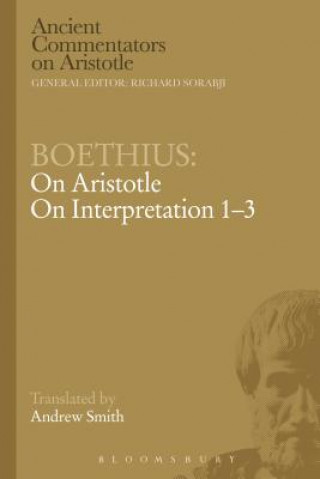
Książka Boethius: On Aristotle On Interpretation 1-3 Boethius

Boethius: On Aristotle On Interpretation 1-3

Autor: Boethius
Język: Angielski
Oprawa: Twarda
Dostępność: Dostępna u dostawcy
Wysyłamy za 10-18 dni
775.44
Boethius (c. 480-c. 525) wrote his highly influential second commentary on Aristotle's On Interpreta...


Informacje o książce

Autor
Język
Angielski
Oprawa
Książka - Twarda
Data wydania
2010
strony
176
EAN
9780715639184
ISBN
0715639188
Enbook ID
04437295
Waga
436
Wymiary
162 x 241 x 20

Pełny opis

Boethius (c. 480-c. 525) wrote his highly influential second commentary on Aristotle's On Interpretationin Latin, but using the style of the Greek commentaries on Aristotle. It was part of his project to bring knowledge of Plato and Aristotle to the Latin-speaking world of his fellow Christians. The project was cruelly interrupted by his execution at the age of about 45, leaving the Latin world under-informed about Greek Philosophy for 700 years. Boethius reveals to us how On Interpretation was understood not only by himself, but also by some of the best Greek interpreters, especially Alexander and Porphyry. Alexander had insisted that its subject was composite thoughts, not composite sentences nor composite things - it is thoughts that are primarily true or false. Although Aristotle's first six chapters define name, verb, sentence, statement, affirmation and negation, Porphyry had claimed that Aristotelians believe in three types of name and verb, written, spoken and mental, in other words a language of the mind. Boethius discusses individuality and ascribes to Aristotle a view that each individual is distinguished by having a composite quality that is not merely unshared, but unshareable. Boethius also discusses why we can still say that the dead Homer is a poet, despite having forbidden us to say that the dead Socrates is either sick or well. But Boethius' most famous contribution is his interpretation of Aristotle's discussion of the threat of that tomorrow's events, for example a sea battle, will have been irrevocable 10,000 years ago, if it was true 10,000 years ago that there would be a sea battle on that day. In Boethius' later "Consolation of Philosophy", written in prison awaiting execution, he offered a seminal conception of eternity to solve the related problem of future events being irrevocable because of God's foreknowledge of them.

Możesz być zainteresowany

Outlander

Gil Adamson
40.10

Luscious

Alison Tyler
63.86

123 VAVAVROOM

Sarah Lynn
57.72

Russia and the Russians

Geoffrey Hosking
159.36
123.15

Nemesis Syndrome

Walt Branam
88.88
163.94

Crooked Kingdom

Leigh Bardugo
37.57
110.59
65.90

Rainbow Dreaming-A Big Book of Calm

Amy (Flinders University of South Australia) Hamilton
60.35

Angels

Clarke
58.11
44.48

The Land and the Cross

Valentina Burgassi
859.75

Gambara

Honore De Balzac
46.72

Etsy for Beginners

The Passive Income Strategist
68.14

Why Do I Keep Doing This!!?

Pearson Judith E Pearson
13.04

Klienci, którzy kupili tę książkę, kupili również

Štvanice

Antonín Thurnwald
18.98
304.13
41.76
56.26

Sermons - tome 2

Léon le Grand
141.84
13.72

Prisma Evaluación (A1/A2) Audio CDs (2) + 1 CD PDFs

Noelia González Verdejo y Jan Peter Nauta
195.09

TODAVÍA HAY PRIMAVERA. TODAVÍA

JOAQUIN ANTONIO PEÑALOSA
87.81

Schul-Spuren

Stefan Rogal
176.21

Dobra Púrpura

Walter Sasso
33.28

Hemisféry

Kamil Bouška
20.53
262.37