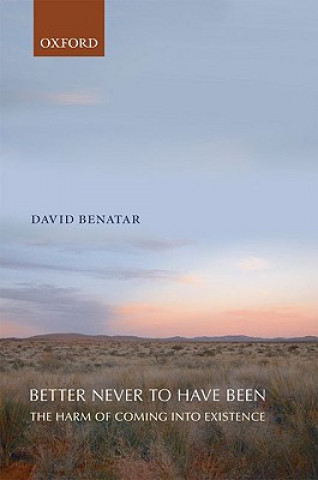
Książka Better Never to Have Been David Benetar

Better Never to Have Been

Autor: David Benetar
Język: Angielski
Oprawa: Miękka
Dostępność: Dostępna u dostawcy
Wysyłamy za 3-6 dni
167.53
Most people believe that they were either benefited or at least not harmed by being brought into exi...

Informacje o książce

Język
Angielski
Oprawa
Książka - Miękka
Data wydania
2008
strony
256
EAN
9780199549269
ISBN
0199549265
Enbook ID
04035747
Waga
304
Wymiary
129 x 204 x 14

Pełny opis

Most people believe that they were either benefited or at least not harmed by being brought into existence. Thus, if they ever do reflect on whether they should bring others into existence---rather than having children without even thinking about whether they should---they presume that they do them no harm. Better Never to Have Been challenges these assumptions. David Benatar argues that coming into existence is always a serious harm. Although the good things in one's life make one's life go better than it otherwise would have gone, one could not have been deprived by their absence if one had not existed. Those who never exist cannot be deprived. However, by coming into existence one does suffer quite serious harms that could not have befallen one had one not come into existence. Drawing on the relevant psychological literature, the author shows that there are a number of well-documented features of human psychology that explain why people systematically overestimate the quality of their lives and why they are thus resistant to the suggestion that they were seriously harmed by being brought into existence.The author then argues for the 'anti-natal' view---that it is always wrong to have children---and he shows that combining the anti-natal view with common pro-choice views about foetal moral status yield a 'pro-death' view about abortion (at the earlier stages of gestation). Anti-natalism also implies that it would be better if humanity became extinct. Although counter-intuitive for many, that implication is defended, not least by showing that it solves many conundrums of moral theory about population.
Możesz być zainteresowany

No Longer Human

Osamu Dazai
53.10

What We Owe to Each Other

Thomas M. Scanlon
133.64
29.02

This Is Water

David Foster Wallace
63.60
363.20

The Stranger

Albert Camus
62.61

Skin in the Game

NASSIM NICHOL TALEB
40.81

The Genealogy of Morals

Friedrich Nietzsche
26.15
59.83
44.57

Prince

Niccoli Machiavelli
25.95

Beyond Good and Evil

Friedrich Nietzsche
27.83

Idiot

Fyodor Dostoevsky
23.37

Birth of the Clinic

Michel Foucault
112.54
156.53

Sapiens

Yuval Noah Harari
51.01

Dark Alliance

Gary Webb
87.47

Klienci, którzy kupili tę książkę, kupili również

237.77
49.63

Human Predicament

David Benatar
137.51
49.63

The Denial of Death

Ernest Becker
53.79

The Life of a Stupid Man

Ryunosuke Akutagawa
15.25

The Philosophy of Redemption

Philipp Mainländer
66.07
41.30

Paradise Lost

John Milton
41.50

The Resurrectionist

E. B. Hudspeth
78.85

Nausea

Jean-Paul Sartre
50.52
69.64

Invisible Cities

Italo Calvino
49.63

Master and His Emissary

Iain McGilchrist
75.09
49.63
44.57
215.68
97.48
27.83
38.43
35.06

White Nights

Fyodor Dostoyevsky
13.17