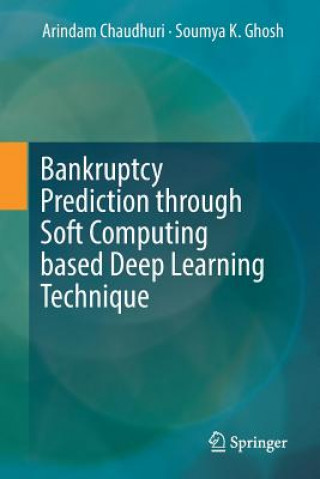
Książka Bankruptcy Prediction Through Soft Computing Based Deep Learning Technique Arindam Chaudhuri

Bankruptcy Prediction Through Soft Computing Based Deep Learning Technique

Język: Angielski
Oprawa: Miękka
Dostępność: Dostępna u dostawcy w małych ilościach
Wysyłamy za 13-18 dni
240.27
This book proposes complex hierarchical deep architectures (HDA) for predicting bankruptcy, a topica...


Informacje o książce

Język
Angielski
Oprawa
Książka - Miękka
Data wydania
2017
strony
102
EAN
9789811066825
ISBN
9811066825
Enbook ID
18131332
Waga
204
Wymiary
234 x 155 x 14

Pełny opis

This book proposes complex hierarchical deep architectures (HDA) for predicting bankruptcy, a topical issue for business and corporate institutions that in the past has been tackled using statistical, market-based and machine-intelligence prediction models. The HDA are formed through fuzzy rough tensor deep staking networks (FRTDSN) with structured, hierarchical rough Bayesian (HRB) models. FRTDSN is formalized through TDSN and fuzzy rough sets, and HRB is formed by incorporating probabilistic rough sets in structured hierarchical Bayesian model. Then FRTDSN is integrated with HRB to form the compound FRTDSN-HRB model. HRB enhances the prediction accuracy of FRTDSN-HRB model. The experimental datasets are adopted from Korean construction companies and American and European non-financial companies, and the research presented focuses on the impact of choice of cut-off points, sampling procedures and business cycle on the accuracy of bankruptcy prediction models. The book also highlights the fact that misclassification can result in erroneous predictions leading to prohibitive costs to investors and the economy, and shows that choice of cut-off point and sampling procedures affect rankings of various models. It also suggests that empirical cut-off points estimated from training samples result in the lowest misclassification costs for all the models. The book confirms that FRTDSN-HRB achieves superior performance compared to other statistical and soft-computing models. The experimental results are given in terms of several important statistical parameters revolving different business cycles and sub-cycles for the datasets considered and are of immense benefit to researchers working in this area.

Możesz być zainteresowany

171.83
129.96
25.50

Smooth-Talking Dog

Roberto Castillo Udiarte
52.86
172.99

2016

Jd Foster
169.29
37.57
79.34

Paths to Reform

Sandra Hindman
136.97

Life You Want

Adam Phillips
76.12
110.78

Real Essentialism

David S. Oderberg
309.29

Klienci, którzy kupili tę książkę, kupili również

Grundung Prags

Clemens Brentano
168.61
61.72

Weltbilder

Airpano
92.28
127.14

Matkatoveri

Andersen
16.35

Océanos

Susaeta
68.43
36.40

Llibràlegs

Prat i Coll
67.75
99.10

Louis de Funès

Jelot-Blanc
55.87

Každému jeho hřivnu

Martin Nesměrák
50.42