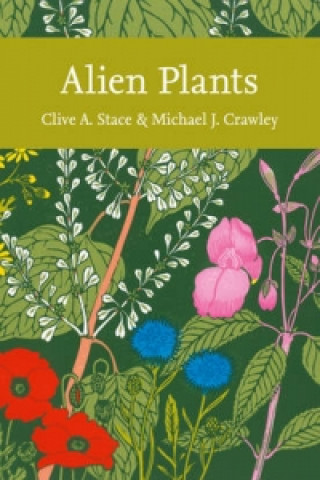
Książka Alien Plants Clive A. Stace

Alien Plants

Język: Angielski
Oprawa: Miękka
Dostępność: 50 % szansa
Przeszukamy cały świat
161.41
The word 'aliens' is used in many contexts, conjuring up a range of sentiments including fear, disli...

Informacje o książce

Język
Angielski
Oprawa
Książka - Miękka
Data wydania
2015
strony
640
EAN
9780007502141
ISBN
0007502141
Enbook ID
04485499
Waga
1336
Wymiary
216 x 154 x 40

Pełny opis

The word 'aliens' is used in many contexts, conjuring up a range of sentiments including fear, dislike and also fascination. It is used to describe strange beings from Mars, human migrants, and non-native plants and animals - the term is employed by biologists to indicate organisms that have been introduced by people to new territories. Alien plants are the topic of interest of many professional research teams and amateur enthusiasts around the world. As a group these plants are common, conspicuous, pestiferous, beautiful, edible, and otherwise useful or harmful. In the British Isles there are very roughly as many species of naturalised or recurrent alien flowering plants as natives and, besides that, there are numerous other less common ones. Many species have been an integral part of our wild flora for such a long time that we can no longer be sure whether they are in fact native or alien. Even some recently discovered species are similarly problematic. Aliens are proving to have such wide interest simply because they cannot be ignored, and because they add diversity to our otherwise rather limited flora. Many of them have profound effects on the environment by competing with native vegetation or by populating empty ground. Others have altered the course of evolution by their genetic interactions with natives. Alien plants in the British Isles, whether they be food-plants or pests, are a major and largely measurable factor in our economy. The two most important features that make alien plants so interesting are that they evolved somewhere else, and that they left behind many (if not all) of their co-evolved species when people moved them to the British Isles. Their genotypes were forged during interactions with a different set of plants, fungi, micro-organisms and animals from those with which they now cohabit, many of which have been left behind in their countries of origin. In contrast, the genotypes of native plant species evolved during an evolutionary history that was spent interacting with the roughly the same set of plants and animals with which they interact today. These two features - uncoupled evolutionary history, and missing herbivores, pollinators and mutualists - make the study of alien plants and their ecological relationships with native vegetation uniquely attractive.

Możesz być zainteresowany

Alien Plants

Clive A. Stace
280.38
170.27

So Pretty a Problem

Francis Duncan
54.41
53.05

Love is in the air

Joanna Lisiak
66.58

American Military Life in Asia

Karl E. Schoelch (Squeaky)
131.32

Candy Savant

A. L. Hawke
55.87

Cardiac Nursing

Elizabeth M. Perpetua
601.36

Long Road Home

H D Thomson
61.03

Zoroastrianism

J. G. R. Forlong
149.53

Son at the Front

Edith Wharton
80.02
18.00

Undertaking

Thomas Lynch
110.98
475.68

Klienci, którzy kupili tę książkę, kupili również

Legislación mercantil básica

Rafael Marimón Durá
132.49
42.44

Dog Man 11

Dav Pilkey
38.25

1000 tenisek

Le Maux Mathieu
80.41
44.19
41.66

Dinosaurios del 1 al 10

MARGARITA DEL MAZO
36.89
107.86
43.80
1 073.45