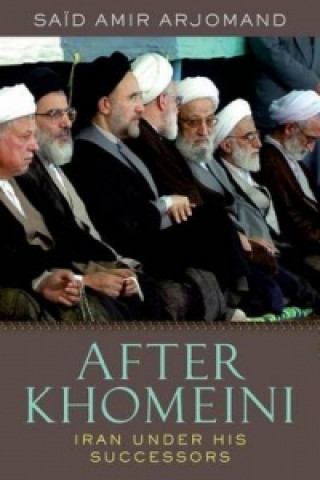
Książka After Khomeini Said Amir Arjomand

After Khomeini

Język: Angielski
Oprawa: Twarda
Dostępność: 50 % szansa
Przeszukamy cały świat
122.87
Iran has not ceased to surprise the world since the American ambassador's famous "thinking the unthi...

Informacje o książce

Język
Angielski
Oprawa
Książka - Twarda
Data wydania
2010
strony
280
EAN
9780195391794
ISBN
0195391799
Enbook ID
04032147
Waga
554
Wymiary
165 x 243 x 29

Pełny opis

Iran has not ceased to surprise the world since the American ambassador's famous "thinking the unthinkable" 1978 cable about the imminent fall of the Shah and the coming of Islamic revolution. The apparent sequence of moderate government of President Hashemi-Rafsanjani (1989-97) and democratic reform under President Khatami (1997-2005) was followed by the return of the hardliners and revolutionary populism coupled with an aggressive foreign policy, including a nuclear program. Iran's political regime has proved remarkably resilient through all these changes, despite the disaffection of the younger half of the population, and become all the stronger, partly as a result of the Bush administration's ill-advised bluff about regime change. The death of Imam Khomeini as its charismatic leader in 1989 did not mean the end of the Islamic revolution, but only the beginning of a prolonged struggle among the children of the revolution over Khomeini's heritage. The integrative social revolution begun in 1979 has continued quietly, while the raucous/noisy struggle to define, structure and control the new Islamic political order set up by Khomeini among different factions of his followers has produced a unique political regime which defies understanding. Arjomand draws on the sociology of revolution to offer a general explanation of political developments in Iran in the last two decades while seeking to understand its unique features in terms of constitutional politics of the creation of the post-revolutionary order. Not only Iran's domestic politics but also its foreign policy are shown to follow a pattern typical of the great revolutions. Surprising as it may seem, the parameters for Iran's constitutional politics in the last two decades are those set by Khomeini's mixture of theocratic, republican and populist elements in the ideology of the Islamic revolution.

Możesz być zainteresowany

308.17
77.55
59.36

Hyacinth

George A Birmingham
49.93

Diabetic Foot Syndrome

Dirk Hochlenert
752.11

Practitioner Joy

Rich Murphy
86.79
64.87

Siblings

Brigitte Reimann
40.79

Small Spaces

Katherine Arden
35.87

Black Women's Activism

Rita B. Dandridge
151.48

Manifestly Haraway

Donna J. Haraway
65.56
476.47
256.37

Georgia O'Keeffe

Randall C Griffin
71.16
80.30

After the Party

Andrew Feinstein
121.00

Klienci, którzy kupili tę książkę, kupili również

Sweet Home

Dan Pešta
117.86
62.12
48.75

Element

Filip Kulisev
121.30
124.25
94.56
22.99