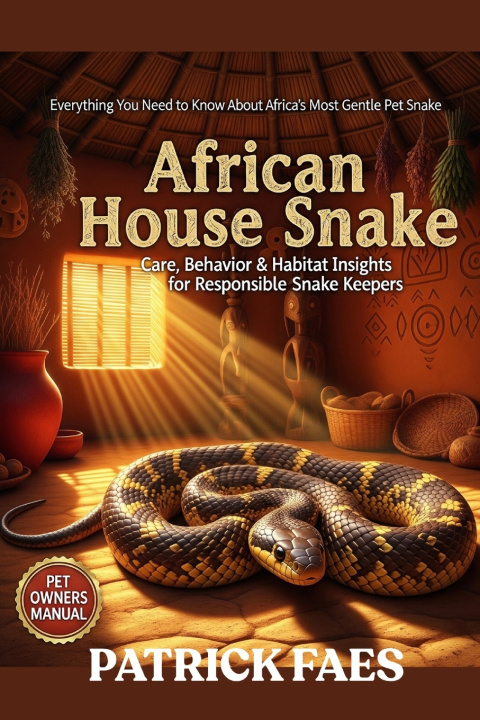
Discover the calm and curious nature of the African House Snake, an ideal reptile for both beginners and enthusiasts. This detailed guide covers species identification, feeding routines, enclosure design, and breeding techniques.
Gain insights into their natural habitats and ecological importance as pest controllers.
The African House Snake, scientifically known as Boaedon fuliginosus, is a non-venomous colubrid snake widely appreciated for its calm temperament, adaptability, and usefulness in controlling pest populations around human settlements. These snakes are often referred to as "house snakes" due to their tendency to inhabit areas near or within homes, barns, and agricultural structures, where they naturally regulate populations of rodents and other small vertebrates.
Historically, the African House Snake has been recognized in African cultures not only as a practical guardian against pests but also in some regions as a symbol of domestic safety. Unlike many snakes that are misunderstood or feared, B. fuliginosus has long enjoyed a unique place in the daily lives of people, quietly contributing to ecological balance.
In the wild, African House Snakes demonstrate remarkable adaptability. They inhabit a wide range of environments, from savannas and grasslands to forest edges and even urban areas. This adaptability has allowed them to coexist with humans over centuries, often thriving where other snake species would struggle. Their calm demeanor, relative ease of handling, and non-aggressive nature have made them a species of interest for both hobbyists and educators in the field of herpetology.
Moreover, their role in traditional and modern pest control highlights an early form of human-wildlife coexistence, where a species provides tangible ecological and economic benefits without posing significant danger. Today, African House Snakes are increasingly studied for their behavior, adaptability, and husbandry requirements, reflecting a growing recognition of their ecological and educational importance.
The African House Snake (Boaedon fuliginosus) possesses a highly specialized musculoskeletal system that allows for both stealthy hunting and agile movement through diverse habitats. Unlike mammals, snakes have evolved a limbless body plan supported by an elongated axial skeleton, giving them remarkable flexibility and efficiency in locomotion.
Skeleton:
The backbone of the African House Snake consists of over 200 vertebrae, each attached to a pair of ribs. This elongated vertebral column provides structural support, flexibility, and the ability to perform complex movements such as coiling, climbing, and constricting prey.
The skull is lightweight yet robust, featuring highly kinetic joints between cranial bones. This kinetic skull allows the snake to swallow prey larger than its head diameter by enabling extensive expansion of the jaw.
No limbs are present, but vestigial pelvic spurs may exist in some lamprophiids, remnants of ancestral hind limbs, although they are functionally insignificant in house snakes.