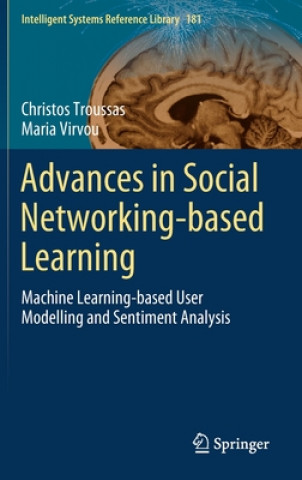
Książka Advances in Social Networking-based Learning Christos Troussas

Advances in Social Networking-based Learning

Machine Learning-based User Modelling and Sentiment Analysis

Język: Angielski
Oprawa: Twarda
Dostępność: Dostępna u dostawcy
Wysyłamy za 10-13 dni
598.81
This book discusses three important, hot research issues: social networking-based learning, machine...

Informacje o książce

Język
Angielski
Oprawa
Książka - Twarda
Data wydania
2020
strony
176
EAN
9783030391294
Enbook ID
25352061
Waga
454
Wymiary
155 x 235 x 16

Pełny opis

This book discusses three important, hot research issues: social networking-based learning, machine learning-based user modeling and sentiment analysis. Although these three technologies have been widely used by researchers around the globe by academic disciplines and by R&D departments in the IT industry, they have not yet been used extensively for the purposes of education. The authors present a novel approach that uses adaptive hypermedia in e-learning models to personalize educational content and learning resources based on the needs and preferences of individual learners. According to reports, in 2018 the vast majority of internet users worldwide are active on social networks, and the global average social network penetration rate as of 2018 is close to half the population. Employing social networking technologies in the field of education allows the latest technological advances to be used to create interactive educational environments where students can learn, collaborate with peers and communicate with tutors while benefiting from a social and pedagogical structure similar to a real class. The book first discusses in detail the current trend of social networking-based learning. It then provides a novel framework that moves further away from digital learning technologies while incorporating a wide range of recent advances to provide solutions to future challenges. This approach incorporates machine learning to the student-modeling component, which also uses conceptual frameworks and pedagogical theories in order to further promote individualization and adaptivity in e-learning environments. Moreover, it examines error diagnosis, misconceptions, tailored testing and collaboration between students are examined and proposes new approaches for these modules. Sentiment analysis is also incorporated into the general framework, supporting personalized learning by considering the user's emotional state, and creating a user-friendly learning environment tailored to students' needs. Support for students, in the form of motivation, completes the framework. This book helps researchers in the field of knowledge-based software engineering to build more sophisticated personalized educational software, while retaining a high level of adaptivity and user-friendliness within human-computer interactions. Furthermore, it is a valuable resource for educators and software developers designing and implementing intelligent tutoring systems and adaptive educational hypermedia systems.

Możesz być zainteresowany

460.54
80.19

London Accident

Jerzy E Henisz
42.90

Que Se Yo de Geografia

Kenneth C Davis
51.36
135.30

Semaphorin Signaling

Jonathan R. Terman
460.54
80.88
84.33

Hot Coals

Jeroen Hazebroek
59.72
284.98

Saga Book Four

Brian K Vaughan
157.15
418.82

Klienci, którzy kupili tę książkę, kupili również

30.01
28.04
157.35

Odzyskanie

Anna Robak-Reczek
37.58

Menstruation

Krieger Eduard Krieger
78.32