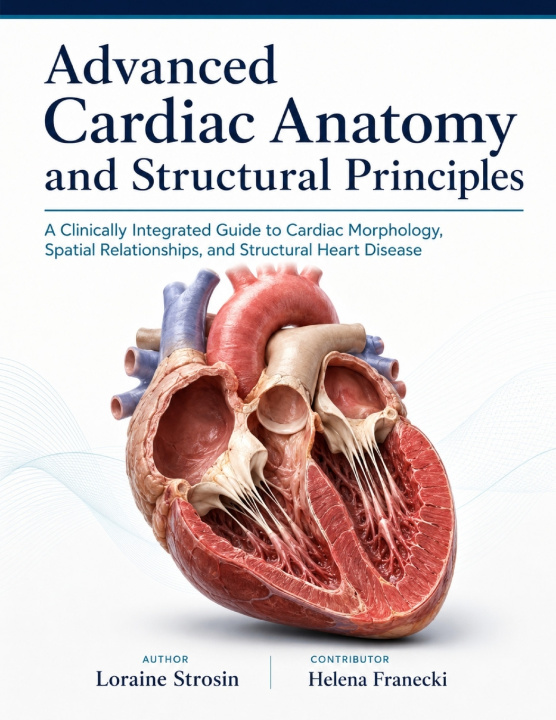
Master the three-dimensional architecture behind cardiac imaging, intervention, and structural disease.
Advanced Cardiac Anatomy and Structural Principles is a clinically integrated reference for readers who need more than memorized chamber names and flat diagrams. It explains how cardiac form, orientation, tissue continuity, and neighboring structures influence hemodynamics, electrical activation, multimodality imaging, surgery, electrophysiology, and catheter-based treatment.
Designed for medical students, residents, fellows, cardiologists, imaging professionals, cardiac surgeons, anesthesiologists, and structural heart teams, this comprehensive text moves systematically from thoracic position and embryologic development to chambers, septa, valves, fibrous tissues, coronary circulation, conduction pathways, autonomic supply, great vessels, and contemporary procedural planning. The progression from foundational orientation to applied structural reasoning helps readers recognize the same structure across gross specimens, echocardiographic windows, cross-sectional datasets, operative exposure, and fluoroscopic projections.
Inside, you will:
- Build a reliable spatial model of the heart within the mediastinum and translate it across clinical viewing planes.
- Trace developmental formation to understand congenital connections, septal defects, and outflow abnormalities.
- Differentiate chamber-specific morphology, valve complexes, fibrous continuities, and myocardial landmarks.
- Interpret cardiac anatomy across echocardiography, computed tomography, magnetic resonance imaging, angiography, and fluoroscopy.
- Connect coronary, venous, lymphatic, neural, and conduction anatomy with procedural risk and clinical decision-making.
- Prepare for valve intervention, septal procedures, electrophysiologic mapping, device placement, and surgical exposure.
- Reinforce essential relationships through clearly positioned figures, chapter objectives, summaries, and key terminology.
Rather than treating structures as isolated labels, the book repeatedly asks where each feature lies, what surrounds it, and why the relationship matters. This method supports durable learning, stronger anatomical recall, and more precise communication among clinicians who approach the same organ from different specialties and viewing angles.
Develop a clinically useful understanding of cardiac form and confidently move from anatomical structure to imaging interpretation, disease mechanism, and procedural planning.