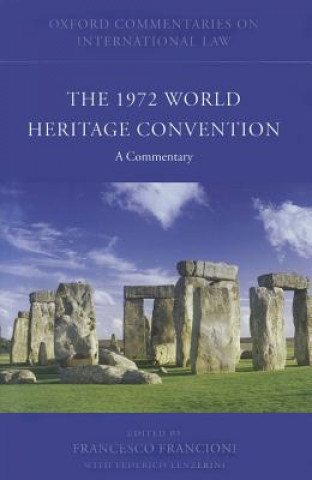
Książka 1972 World Heritage Convention Francioni Ed

1972 World Heritage Convention

Autor: Francioni Ed
Język: Angielski
Oprawa: Twarda
Dostępność: Dostępna u dostawcy
Wysyłamy za 10-18 dni
770.56
The World Heritage Convention (WHC) is the most comprehensive and widely ratified among UNESCO treat...
Informacje o książce

Autor
Język
Angielski
Oprawa
Książka - Twarda
Data wydania
2008
strony
600
EAN
9780199291694
ISBN
0199291691
Enbook ID
04477955
Waga
1076
Wymiary
241 x 165 x 39

Pełny opis

The World Heritage Convention (WHC) is the most comprehensive and widely ratified among UNESCO treaties on the protection of cultural and natural heritage. The Convention establishes a system of identification, presentation, and registration in an international List of cultural properties and natural sites of outstanding universal value. Throughout the years the WHC has progressively attained almost universal recognition by the international community, and even the International Criminal Tribunal for the Former Yugoslavia has recently considered sites inscribed in the World Heritage List as "values especially protection by the international community." Besides, the WHC has been used as a model for other legal instruments dealing with cultural heritage, like the recently adopted (2003) Convention on the Safeguarding of Intangible Cultural Heritage. During its more than 30 years of life, the Convention has undergone extensive interpretation and evolution in its scope of application. Operational Guidelines, which are the implementing rules governing the operation of the Convention, have been extensively revised. New institutions such as the World Heritage Centre, have been established. New links, with the World Bank and the United Nations, have developed to take into account the economic and political dimension of world heritage conservation and management. However, many legal issues remain to be clarified. For example, what is the meaning of "outstanding universal value" in the context of cultural and natural heritage? How far can we construe "universal value" in terms of representivity between the concept of "World Heritage" and the sovereignty of the territorial state? Should World Heritage reflect a reasonable balance between cultural properties and natural sites? Is consent of the territorial state required for the inscription of a World Heritage property in the List of World Heritage in Danger? What is the role of the World Heritage Centre in the management of the WHC? No comprehensive work has been produced so far to deal with these and many other issues that have arisen in the interpretation and application of the WHC. This Commentary is intended to fill this gap by providing article by article analysis, in the light of the practice of the World Heritage Committee, other relevant treaty bodies, as well as of State parties and in the hope that it may be of use to academics, lawyers, diplomats and officials involved in the management and conservation of cultural and natural heritage of international significance.

Możesz być zainteresowany

Funny Fish

Michaela Morgan
35.64
234.01

Francis Bacon

Anna Maria Wieland
81.35

Poison Tree

Erin Kelly
54.30
901.10

Klienci, którzy kupili tę książkę, kupili również